IN CONVERSATION
“Once you have focused on who you are and what you want,
you must concentrate on the goodness of your choice and go for it.”
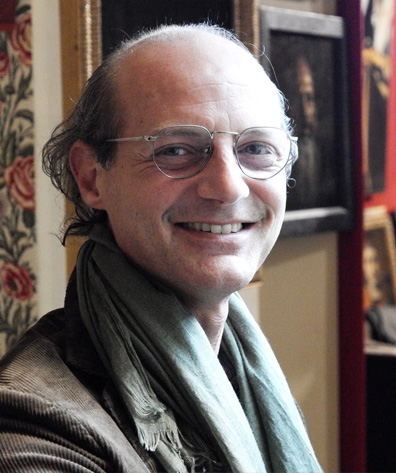
MASSIMO TIZZANO
Classical figurative painter, IT
March 8th, 2023
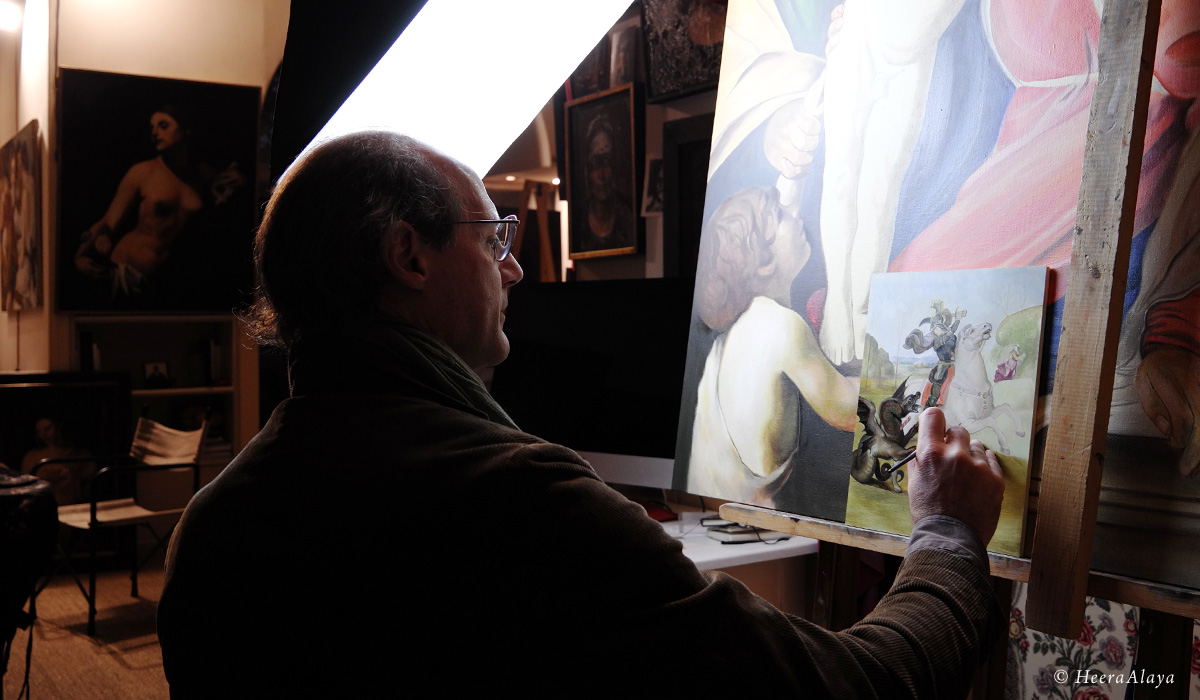
Heera Alaya: The fabric panelling in your atelier [on Via Margutta, Rome, Italy] caught my eye.
Massimo Tizzano: My atelier was originally a tissue shop, and the layout and furnishings were already established when I took it over. I did consider making changes, but ultimately decided to keep them as they are; the fabric tapestry creates a delightful acoustic experience.
The fabric-covered walls do soften the ambience of your atelier. It’s fascinating how this space developed organically for you.
My life is full of unusual coincidences. Many years ago, I had the fortunate opportunity to meet my Norwegian painting master, Odd Nerdrum, just 30 minutes away from my atelier at a bistro adorned with white sculptures—
I know exactly which cafe you’re referring to—it’s the double-level one with the red walls.
Exactly.
Talk about coincidences!
I had an appointment to meet my painting master at Santa Maria di Popolo [beside Piazza del Popolo], but my train was delayed. To make it on time, I took a taxi to the bistro we discussed. As we approached the location, I spotted my painting master, Odd Nerdrum, and instructed the taxi driver, “Please stop here.” This moment was significant for me; it had been two years since I applied to be his studio assistant, and I was finally meeting my painting master.
Exactly ten years later, a dear friend offered me the chance to rent my first Roman atelier [Massimo’s atelier on Via Margutta, Rome], just 30 meters from that very bistro where I first met my painting master.
Incredible.
It was a significant period in my life. The day before my friend informed me about the opportunity to rent this property [Massimo’s Roman atelier], my wife and I were feeling down due to the hardships brought on by COVID-19. We [Massimo and his wife] had been contemplating setting up a small gallery near our home in Calabria [Southern Italy], in the picturesque tourist town of Diamante. While things seemed to align, we were unable to finalise a favourable arrangement for the gallery property.
The evening before meeting my friend [who recommended the property in Rome], I encouraged my wife not to dwell on her sadness, saying, “We will have a new opportunity tomorrow.” And the moment we so badly wanted arrived exactly the day after.
You have studied Indian music and Japanese calligraphy. How have these diverse subjects contributed to your growth as an artist?
From a young age, I was attuned to both music and art, often drawing or playing musical instruments. However, my family encouraged me to pursue a path that was quite different from my passions, which led me on a lengthy journey before I finally embraced painting.
During this period, I studied Japanese martial arts and Indian classical music (with some talented masters from India), as well as tabla and sitar, with the help of the Fondazione Giorgio Cini in Venezia—a foundation that bridges Eastern and Western cultures.
My turning point came when I met Norio Nagayama, my master in Japanese calligraphy. I dedicated about ten years to rigorous training under his mentorship. In Japan, much like in India, there is a profound respect for one’s masters, and the process of learning art often involves emulating the Old Masters. So when I decided to move from my hometown, Padua [Northern Italy], to Calabria, I found myself with some free time and oil paints, and I thought: “Let’s see what happens.” Much like my journey with Japanese calligraphy, I began to replicate the works of the Old Masters. Eventually, I ventured to sell my creations, and to my surprise, it turned out to be quite successful. [Laughs]
Would it be accurate to credit Japanese calligraphy as a foundational element in your journey toward your passion for painting?
Absolutely. All my experiences and learnings are intricately connected to painting. My travels to the East enriched my perspective, and upon returning to the West, I brought with me invaluable lessons. The distinction between the West and the East lies in the West’s tendency to overlook the significance of our historical and cultural heritage.
Indian classical music constantly references the past— exemplified by a singing style called Dhrupad, which means unchangeable. The same sentiment holds in Japan—traditional arts have endured for centuries. They [arts] were transmitted from mouth to ear for many years, directly from the master to the pupil. You cannot find this tradition in the Western world anymore.
You appreciate your journey to the East.
For sure. I consider it essential to my growth as a person. What I was unable to discover in the West, I found in the East. I believe it is crucial for those in the Western world to undertake their own journey to the East in search of a master who can impart profound teachings.
You emphasise the importance of personal development. One can reside in a stunning location, but true growth occurs when we step outside our comfort zones and immerse ourselves in diverse experiences over time (in the truest sense of travelling).
For sure.
You have travelled extensively, including to Norway and Japan. How have these journeys impacted you personally?
The intriguing aspect of this journey is the interplay between the external world and our inner selves. By learning a traditional art, you can reach a point where these two realities become one, so you become one. You find that your heart is the heart of other people and nature, and your breath is the breath of the universe.
How long have you been painting?
About fourteen years.
What ultimately motivated you to pursue painting?
When I painted, I found myself in a meditative state. I could spend hours creating without feeling tired. It’s crucial to engage in work that doesn’t deplete or harm you, which led me to the decision to pursue painting.
Have you ever started a painting and then abandoned it because it didn’t turn out as you envisioned?
Yes, I’ve had many such experiences. [Pointing to a painting] Take that one, for instance; I went through three or four versions before deciding to set it aside. [Laughs]. If someone were to X-ray my paintings, much like the Old Masters, they would discover significant alterations beyond just the positioning of a finger.
How did you manage to convince your painting mentor, Odd Nerdrum, to take you on as a student?
I was already painting when I first encountered Odd Nerdrum’s work and believed he was a 17th-century master. When I discovered that he [Odd Nerdrum] was alive and accepting students, I made an effort to reach out to him. I connected with his wife, Turid, on Facebook, and she asked me to send photographs of my work along with a presentation letter. My painting master approved my application, but also asked me to submit a self-portrait, which I did. They [Odd Nerdrum and Turid] responded: “We are coming to Rome. Can you meet us?” We arranged to meet in Rome.
Risk-taking is essential. We often grapple with self-doubt—wondering, “Should I?” “What if?” “Could I?”
It’s important to pursue our paths, even if it requires effort and entails some risks. In the Christian perspective, Jesus speaks of a wide path and a narrow one.
Are you referring to our approach to life?
Indeed. There are both easier and more challenging ways to navigate life. Typically, we tend to choose the easier route to avoid complications, yet in doing so, we often sacrifice a part of ourselves. If you wish to remain true to your beliefs, aspirations, and identity, you must be willing to exert some effort and embrace the more difficult path.
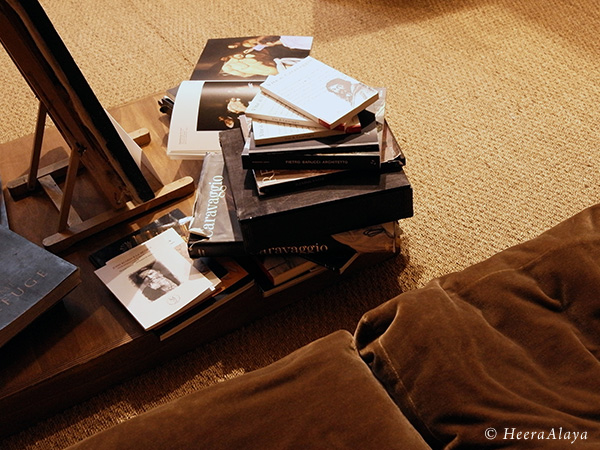
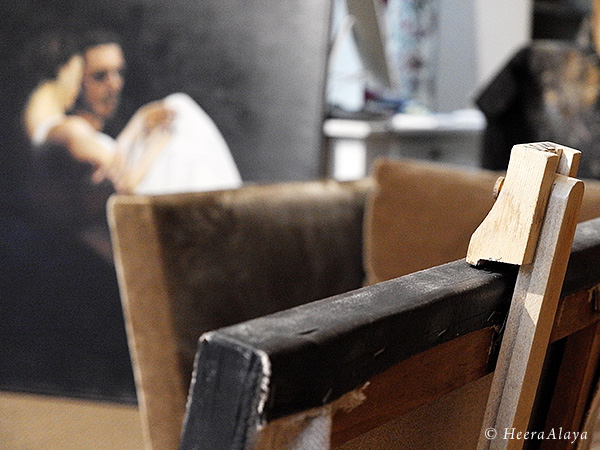
What is it about the Italian Baroque painter Caravaggio that inspires you?
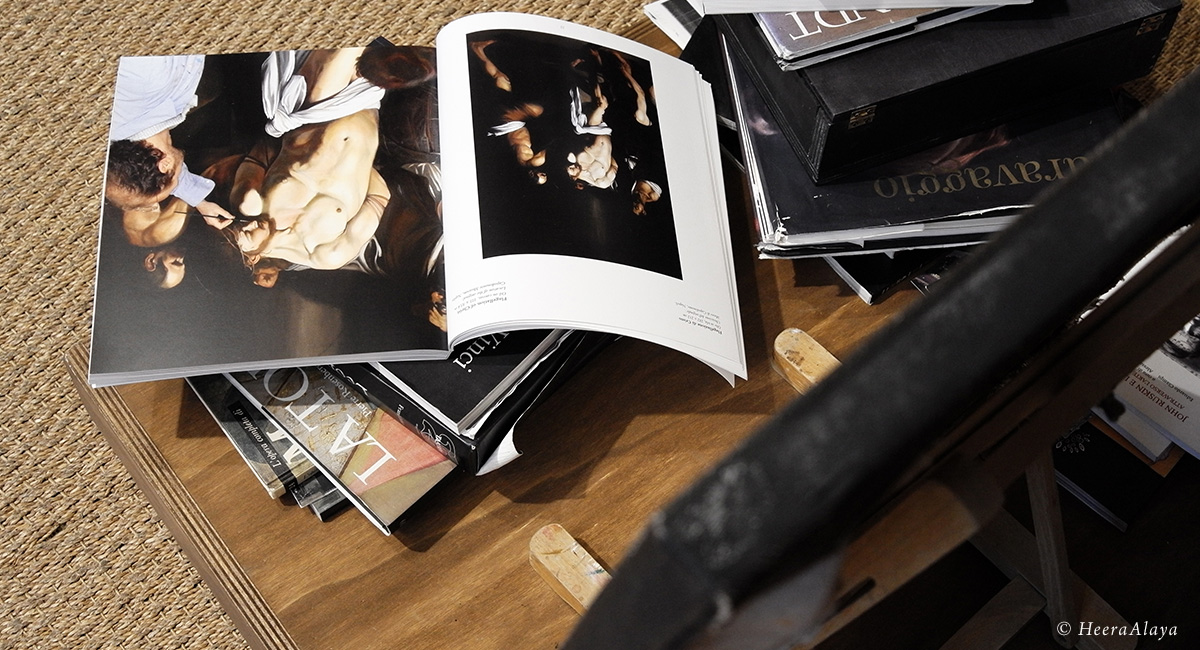
Caravaggio’s role in a period of significant artistic evolution, spurred by the patronage of the ecclesiastical community, noble courts, and affluent merchants. Amidst this flourishing era, Caravaggio emerged as a figure brimming with energy, a strong personality, and a profound understanding of the finest Greek art. His [Caravaggio’s] pictorial flair and vision of his own existence made him the father of a new, never-before-seen painting style: realism.
His iconic fruit basket, featuring a rotten apple, withered grapes, and a crumpled fig leaf, marks the dawn of a new perspective in art. With Caravaggio, it feels as though painting has transitioned from the realm of Platonic ideals to that of Aristotelian realism.
Caravaggio’s work is much better than most contemporary art and postmodern work, inspiring many people, myself included. But I am a critic of the prominent painter [Caravaggio].
What do you mean when you say you are a critic of Caravaggio?
More than critiquing him directly, I find myself critical of the historical epigones that emerged from his revolutionary style. There’s no doubt that Caravaggio was a genius.
Caravaggio had excellent skills and was also a great scholar, an unknown aspect of his personality. But his [Caravaggio] paintings changed, becoming more about theatre than an instrument for contemplation.
Caravaggio possessed exceptional skills and was also a remarkable scholar—an often overlooked aspect of his character. However, his paintings evolved, becoming more about theatre than an instrument for contemplation. For example, in the medieval world, when they made icons—they are still done today—it was instructive as a work of art; an icon tells a religious story. But the main reason icons were made is that they embody sacred geometry, such as a mandala [geometric configuration] or a yantra, which you use for contemplation to enter another state of mind, bringing you greater depth within yourself.
With Caravaggio, everything is spectacular, like special effects—you have the light and the compositional dynamism, and it is close to theatre, a dimension I like. Caravaggio still has something important to give to humanity, especially these days. Nowadays, people look at paintings and say, “This is good for my space; it has nice colours like my sofa.” People don’t look for emotions or a story; they look at the aesthetics—if it [painting] fits with the dining room, it’s good. But what do they want when they go to the cinema? People look for something that gives them emotion. In Caravaggio’s artwork, that emotional depth is undeniably present.
Can you share your thoughts on the Dutch artists you study?
Let’s discuss Rembrandt, for instance. There are two elements I focus on in a painting, which also reflect my eclectic approach: the spiritual and the human. There are spiritual and human aspects. So you have the finite (the representation of the human limits) and the infinite (the representation of the unknown).
In Rembrandt’s work, particularly in his later self-portraits, you can clearly sense his humanity. His use of short brush strokes and the intensity of his expressions convey the sorrow he felt during his final years. Rembrandt’s paintings carry profound spiritual messages; you can see an older man with colours on his palette, capable of expressing deep drama with only a few strokes. In this sombre spiritual state—while we may not wish to feel sadness—we often find comfort, much like the solace we derive from listening to melancholy music.
This sense of sadness also draws me to Van Gogh, the Dutch post-impressionist painter. He was a deeply sensitive soul, and his art possesses an intensity that invites me to be present, allowing me to feel his essence. Van Gogh’s journey, along with letters and paintings, evokes great sadness, moving me to tears.
I remember the first time I cried in front of a Van Gogh painting. It’s a reaction I often hear others express as well—being deeply touched by his work.
Are there other artists who inspire you?
I draw inspiration from numerous artists, particularly certain Flemish painters. My interest is historical; I am interested in their [Flemish painters’] technique and the special effects they could attain in their paintings. Their ability to convey a clear representation of reality is striking. For example, many Flemish painters are skilled at recreating materials—wood, metal, or brocade—in their paintings. It is fascinating to represent all these materials so realistically. To represent reality in such a way, you have to become the reality.
As mentioned earlier, this is an identification process. Leonardo da Vinci emphasised this idea in one of his writings: “If you want to paint something, you have to become what you are representing.”
Also, when contemplating a painting, if you can put yourself aside, you can enjoy it; try to make a space inside you with a clear mind, and let the painting speak to you. In this way, your ear—not your eyes—becomes attuned to what the artwork has to say.
Different art periods employ distinct tones, and it is essential to remain true to each period’s characteristics. How do you organise your work, and what is your approach to mixing colours?
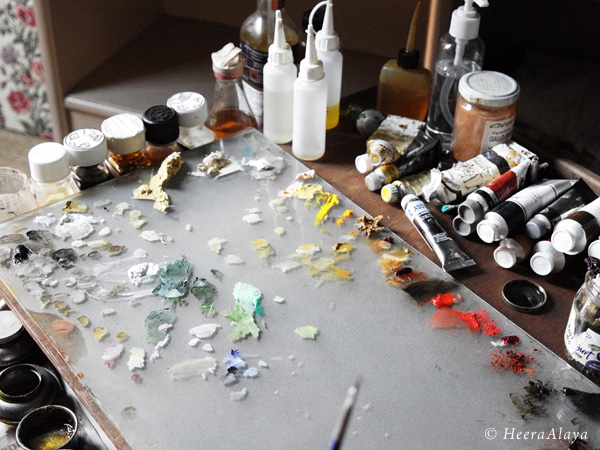
I adhere to the period, materials and mediums. For instance, in the past, artists utilised only walnut and linseed oil, often mixing them with resins and other ingredients. Each master had their own unique mixing techniques. I use a limited palette for my paintings, which I learned from a Roman Scholar, Palma il Vecchio, who explains the palettes of the renowned painters of the past, such as Apelles, the ancient Greek painter known for his depictions of Alexander the Great. By mixing these colours, I can create numerous combinations, allowing for a harmonious interplay of tones and shadows in my work.
Currently, I am working on Raphael [Italian painter] and Caravaggio, both of whom frequently employed the same palette in many paintings. However, to faithfully replicate Raphael’s style, one must incorporate a wide range of colour shades.
You have an extensive range of colours, including various shades of gold. Do you maintain different palettes for different artists?
No, I am not that organised. I take the time to study each painting to determine which pigments I need and then mix the colours accordingly, as they vary from piece to piece. While I have fundamental pigments I prefer, I don’t have a designated box for Raphael, one for Vermeer, and another for Caravaggio.
[Laughter]
How do you achieve the precise colour tones, such as Terre Verte or Burnt Sienna, used by the Old Masters?
I try my best [to get accurate tones]. However, my results will inevitably differ from the originals. Whenever I approach an Old Master study, I always visit a museum to see the original painting, observing it through the lens of its age and the yellowing of the varnish.
To eliminate misunderstanding, one can utilise the results of scientific examinations of the paintings. By taking a small sample and analysing it under a microscope, you can discern the number of layers present, from the ground to the varnish.
The pigments used in old paintings are from a different era. How do you source authentic pigments?
Many large shops offer a wide range of pigments, materials, and antiques. Additionally, you can find sources online. You can also source material through the Internet.
As you travel back in time and experience various eras of painters, do you find that those periods have become a part of you?
I am mirroring myself with these eras. Most people are mirroring someone who reflects them. Our interests often reveal what already resides within us. We need to see its reflection to see it better.
Is there a specific colour pigment that speaks to you?
It’s interesting you say, “a colour speaks to you”—colour is static. My name as a Japanese calligrapher–Oto Mi–is to see the sound. Oto is sound, and Mi is to see. This reflects my desire to visualise sound, akin to experiencing a painting through auditory means, which is a concept prevalent in Indian culture. For example, in Indian culture, musical notes are denoted by Ragas, which means “colour”.
I have a fondness for nearly every colour and appreciate the way they are organised. When there is harmony, it creates beauty. So painting is a question of organisation. The right proportions are essential—the balance of dark and light, the interplay of force and lines, and the precise mixing of colours all contribute to a quality painting.
The pigment I like the least is blue; I consider it somewhat of a poison in painting and believe it should be used sparingly.
How do you stay organised with your brushes and palettes?
I make it a point to organise daily, cleaning my palette and washing my brushes at the end of each day. My painting Master removes some colour with a rag and dips the brushes in linseed oil to keep them soft. However, with this technique, the oil gradually penetrates the bristles. So, I clean my brushes with oil and then wash them with a neutral soap.
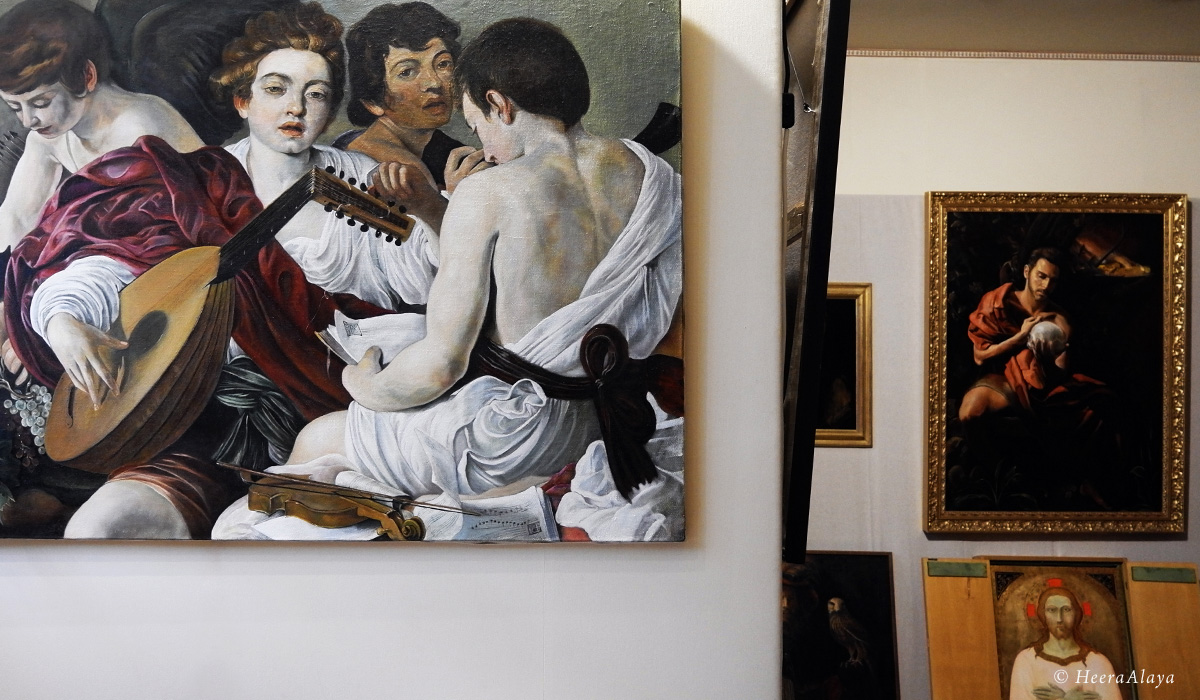
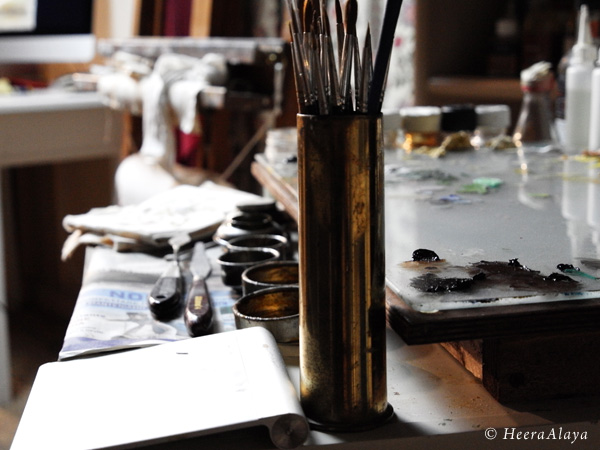
As a sensitive and creative individual, how do you navigate life’s challenges while also focusing on your art?
Creating art while facing life’s difficulties can be quite challenging. Despite societal pressures, global events, and other complex issues, it’s essential to maintain a clear focus and be courageous enough to take risks for the best results. We must also be aware of what we are willing to sacrifice in the pursuit of our artistic goals.
Pardon my interruption. You were painting throughout the challenging COVID period—
Sure.
How did you manage to compartmentalise your concerns and maintain focus on your rituals and techniques to stay on track?
It was indeed a challenge. However, I strive to remain centred. My training in martial arts, Indian classical music, and Japanese calligraphy equipped me with the tools to navigate this difficult time. In this sense, I have been lucky. And I didn’t waste my time before, and I make a concerted effort not to waste a minute now.
So we should live by this philosophy—try not to waste a second, because everything changes so fast.
I had two friends who died recently, like that [gestures in a snap].
We take tomorrow for granted.
Procrastination teaches us a valuable lesson. We must be mindful of the present moment, clarify our intentions, and identify our goals. Being focused doesn’t have to make us anxious about reaching our goals; rather, it helps us work in the now.
And enjoy the process.
It is very important to enjoy the process. You don’t have to think, “I will be happy when I get the result,” you have to be satisfied now.
What is your working process for commissioned projects?
I am not simply interested in accepting an assignment, receiving payment, and delivering the painting. Instead, I ensure that the commissioner is involved throughout the entire process, whether it’s a portrait or a Master study. By engaging the commissioner, I can gather their impressions and better achieve the desired results.
It is a collaborative journey.
Yes.
Does your background in business and commerce assist you in selling your artworks? Or do you have a partner who manages your business affairs?
I recently entered into a partnership agreement with a prominent communications agency. It can be quite challenging to oversee everything on my own. Moreover, I am terrible with social situations.
I wish you the very best.
Thank you. I am delighted and curious to see what this union will bring out.
As my fascination with art grew, I began to closely examine the frames of the Old Masters—ornate designs that encase works by Botticelli [Sandro Botticelli, Italian Renaissance painter], alongside more understated frames that complement Van Gogh [Vincent Willem van Gogh, Dutch Post-Impressionist painter]. How do you select your frames?
Each painting possesses its own unique characteristics, and we must respect those nuances. My approach is intuitive; I seek out frames that enhance a painting, revealing its full potential.
The painting truly dictates the choice.
Yes. [Pointing to a painting featuring Massimo’s nephew] I had an idea for that painting, a scene from Macbeth. I preferred a dark frame inscribed with a well-known monologue from Macbeth, given the painting’s darkness and the brightness of the lady’s dress.
How interesting! Did you commission the frame?
I did. I will show you the frame on my computer.
That will be lovely. Thank you.
If you place a gold frame around a painting like this one [Macbeth], you will ruin it—light around a dark painting kills the painting; you need to lift the painting. And this can be a guiding principle—avoid light frames around dark paintings.
[While admiring the frames in Massimo’s atelier] You rarely encounter such exquisite frames. Do you collaborate exclusively with an Italian framer?
I know several authentic framers who are truly remarkable artists. [Pointing to various frames] Those feature pure gold embellishments.
Your wooden boxes have piqued my interest.
They [wooden boxes] emerged out of a need. I had to ship an attractive painting to Connecticut [USA], a Master Study—Saint Sebastian [1495 painting] by Pietro Perugino, an Italian master of the 15th century. I wanted the client to receive the painting and enjoy it rather than deal with layers of cardboard and plastic.
So, I started constructing a box with a velvet interior, which provided the perfect final touch for my painting. Those were crazy times—I was painting and making boxes.
What does the butterfly on the boxes represent?
The butterfly is a symbol inspired by my Norwegian painting master, Odd Nerdrum.
Is placing a butterfly on the wooden boxes your way of honouring your painting master, Odd Nerdrum?
Yes. I also try to be grateful and think about my masters’ every day, who gave me so much.
How many paintings do you typically work on at one time?
I usually work on three to four [paintings]. I also employ non-direct method of the Old Masters, painting in layers, and allowing each layer to dry before applying the next. This process allows you to work on multiple paintings at once.
Have you ever experienced such a strong emotional attachment to a painting that you didn’t want to part with it?
I feel attached to every painting. There are some I’ve spent more than nine months or even years on, and they have truly become a part of me. But I am happy when I find them a good home, like when a son or daughter finds a good partner. That said, it’s important not to become overly attached to anything.
Buddhism has a concept of non-attachment—
You possess a wealth of knowledge about various disciplines. Are you by any chance a painter?
I appreciate your observation. I wish I were a painter. Basic watercolour painting hardly qualifies. Neither can I play a musical instrument to save my life!!
[Laughter]
I consider myself a sensitive soul driven by curiosity and a passion for learning.
So you can understand.
Absolutely. I can spend hours standing in front of a painting, appreciating the nuances—the light source, the brushwork and the fabric detailing. I am always enamoured by face structures and ornaments from different eras, trying to understand pigments, spatulas, etc., and admiring the frames. When I go into a museum or an atelier, it’s intentional—I want those moments to become part of me.
This intentionality makes all the difference. I listened to a radio program about how people move through a museum, where they were trying to calculate how long people spend in front of a work of art. The number of people who spent three minutes in front of a painting was so negligible that it was insignificant as a percentage. So, the study measured audience attention for 1 minute, which was also insignificant. The study had to be reduced to a few seconds to measure the maximum attention span. Going to a museum and standing in front of a work of art for 10 seconds doesn’t make sense.
I never would have guessed that people zip through museums. But I suspect the day is not too far when a suspicious security guard picks me up and throws me out of a museum for spending way too much time!
[Laughter]
Your nephew served as a model for your painting, which was inspired by one of the most renowned soliloquies in William Shakespeare’s tragedy Macbeth. Does your nephew have to be a live-sitting model, or do you take his photographs?
I often need to take photographs, even though it goes against the teachings of my master, who works only from life. I witnessed his dedication one frigid Norwegian winter while he painted a portrait of his wife—he ventured outside into the biting wind just to fetch a small piece of velvet for her shoulder.
When a real person is in front of you, they radiate energy and resonate with the light, enabling you to infuse depth into your canvas and truly bring it to life.
Copying a Master’s work is different—you already have a human version, a three-dimensional creation on a canvas. But when you make a portrait from a photograph, it is a poor reference as it does not come from a man’s hand and heart. Unfortunately, I work from photos because only some people are in the position to model for you, as it is time-consuming and requires multiple sittings. If you need to copy from a photo, your goal must be to bring that frozen image to life. It also helps to make a short video of the model to have movement.
What are your most significant challenges when painting?
The greatest challenge is creating a painting that exudes a sense of aliveness and becomes a source of positive energy. Even when you have your back to it, the painting should still resonate with vitality.
Speaking of positive energy, I felt it while strolling down Via Margutta one early morning and passing by your atelier; its magnetic energy is palpable.
Energy is not apparent to people, but everything is energy. We surround ourselves with many things, and those crafted with good intentions can truly make a difference.
What significance does it hold for you to have your atelier on Via Margutta?
Are you familiar with its history?
Via Margutta is a beautiful street that once housed the finest artist ateliers. I would love to learn more.
Exactly. Since the 17th century, Via Margutta has been dedicated to the arts and has hosted the most esteemed painters. The father-and-daughter painters, Orazio and Artemisia Gentileschi [Italian Baroque painter], had ateliers on this street. Artemisia was one of the greatest female Renaissance painters (a contemporary of Caravaggio). Many artists chose this street to start workshops because the rent was affordable until the late 20th century. In the 1950s, approximately 800 artists resided here—70 percent painters and 30 percent sculptors. Via Margutta had a vibrant, creative atmosphere. Notably, Picasso [Pablo Ruiz Picasso, a Spanish painter and sculptor] had his first studio in the building directly across from us.
Do you know that the famous Hollywood film Roman Holiday [starring Audrey Hepburn, 1953 Academy Award winner] was shot on this street [Via Margutta]?
I do
And that building facing my atelier was designed to accommodate artist workshops, as noted on the gate: “Studio per pittoti e scultori” [Workshops for painters and sculptors]. However, the real estate market took an interest in Via Margutta, and they began buying properties to turn into luxurious apartments, bed-and-breakfasts, and so on. So, the artists started moving from here because rents were soaring.
Does the energy of Via Margutta influence your work?
For sure. Even if you are only aware of it sometimes, consider the many painters who passed along this street, t the vast array of works and ideas that have emerged here. Via Margutta has an exceptional spirit compared to other shopping streets.
True. The noisy, crowded shopping streets present a stark contrast to the quiet charm of Via Margutta, which has a different vibe.
Yes. Completely different vibe.
You mentioned that your life journey began in a different direction before bringing you to this point. Not all of us are fortunate enough to have perfectly stretched canvases to build our lives. What would you say to youngsters who don’t have a perfectly stretched canvas? How can we undo parts of the canvas and re-stretch it to make it our own story?
It is tough [to re-stretch your canvas]. But once you have focused on who you are and what you want, you must concentrate on the goodness of your choice and go for it. You must not ruminate about what my parents, my brother, or my friend will think. You must defend your right to do what you want, letting the world know you are committed to owning your life and taking risks.
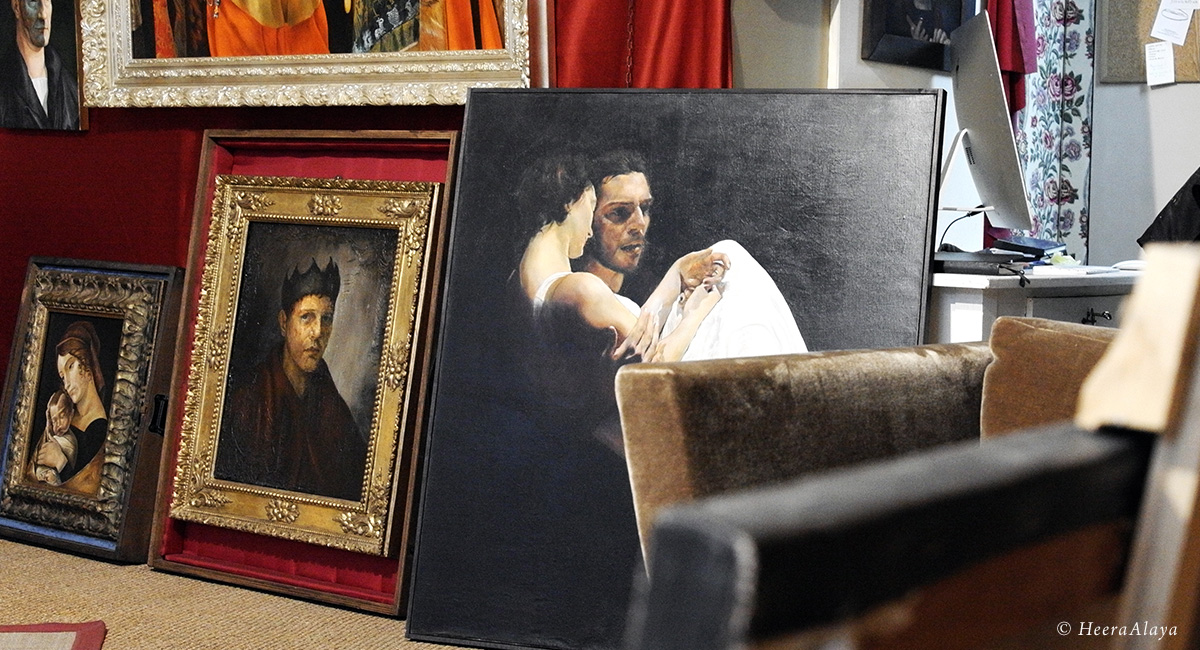
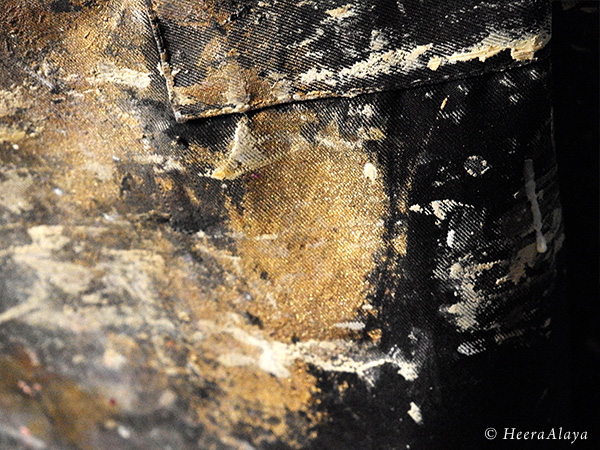
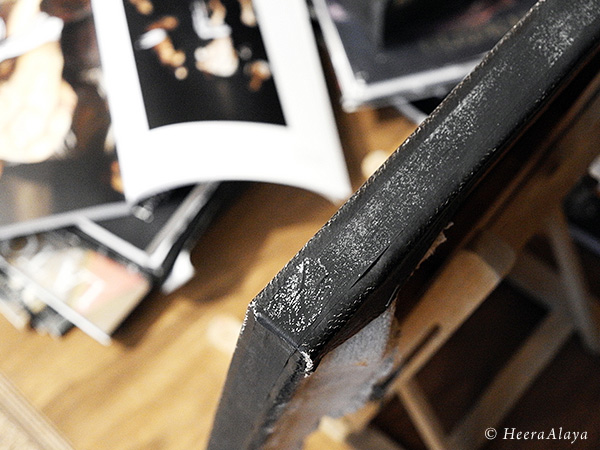
The day of our conversation had pleasant coincidences. Massimo didn’t know his nephew was arriving in Rome; his nephew didn’t know the sold Macbeth painting hadn’t left his uncle’s atelier, and I didn’t know Massimo’s nephew would be present or that I would get to see a photograph of the frame. Sharing this personal, poignant moment with the artist and his model nephew was special. Massimo showed me a picture (on his computer) of the frame he had commissioned for the Macbeth painting. The thought invested in selecting a complementing frame and details—soft gold lettering with a worn-out effect—makes the frame exquisite.
Massimo’s nephew [the model for the Macbeth painting ‘Tomorrow and tomorrow and tomorrow’] expressed his gratitude for his uncle: “Performing the Macbeth scene was an emotional moment. Not only did my uncle [Massimo] capture this moment on film, but he also painted it far better than the film.
Learn more about Massimo Tizzimo.
BEING A BEACON
emblematic of my essence
THE MARIONETTISTS
The master manipulators
KATE BLEWETT
Bulgaria’s Forgotten Children
SONAM WANGCHUK
as you teach, so you grow
EUDAIMONIA
amalgamations and elucidations
LOTTIE ALLEN
Hidcote Manor Garden
ALLISON ARGO
Documentary Filmmaker, USA
“Resiliency is another quality that comes to mind with the individuals I have filmed and profiled. They [animal individuals] have been through so much, yet they are still willing to trust.”