IN CONVERSATION
“You can’t turn back the clock on your age,
but you can turn other aspects of your life around for the positive.”
MARIA GUIDA
Artist, Lucca, IT
March 8th, 2023
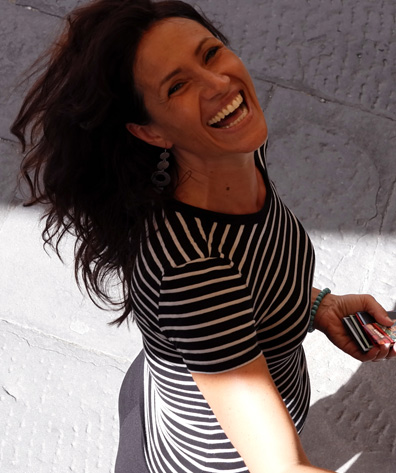
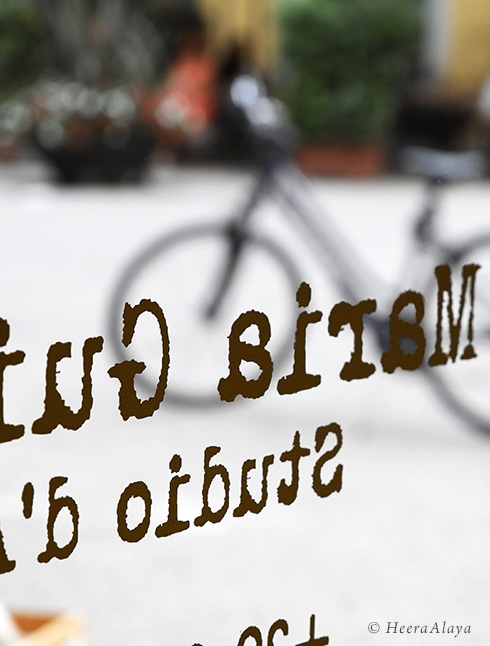
Heera Alaya: Watching you pedal your bike towards your shop cum laboratorio [artist workshop] made me think: What a beautiful sight—a joyous woman on a bike!
Maria Guida: [Laughs] Thank you. I love biking.
If I’m not mistaken, you’re not originally from Lucca, are you?
Sì [Yes]. I am from Napoli [also known as Naples, a southern Italian city].
I’ve heard that Neapolitans are quite friendly. Is that true?
It is true [Maria emphasises true]. People from Napoli are indeed friendly. There’s a unique energy there; you can really sense the openness. In Lucca, however, people tend to be more reserved and disconnected.
How does a welcoming, cheerful person like yourself navigate Lucca’s relatively closed-minded mindset?
I have many friends from southern Italy, and some from Lucca. There is something about my energy—I attract people like me.
I arrived in Lucca 26 years ago, and my family moved here a year later. When I was very young, I suddenly lost my Papa. My Mama knew I wanted to be in Lucca, so she decided to leave Napoli. My Mama, two sisters (each with three children), and one brother (he has a fiancée) live together in Lucca.
What inspired your move to Lucca?
[Laughs] Love, love, love. I knew this man—from Napoli—who worked in Florence [City in central Italy]. He was quite young, around 21, and I married him. We had a daughter named Luna. After our split, I chose to stay in Lucca because it was where Luna went to school and had her friends.
Another reason for my decision was the convenience of life in Lucca. Everything is easily accessible here, while in Naples, it’s often cumbersome. Napoli is vast, and going from one part to another takes time (You must have a lot of money to have quiet in Napoli.). For instance, it’s very stressful to pick up the children from school—it is full of cars and people. In Lucca, everyone is on bikes, which I love.
Life has worked out well for you.
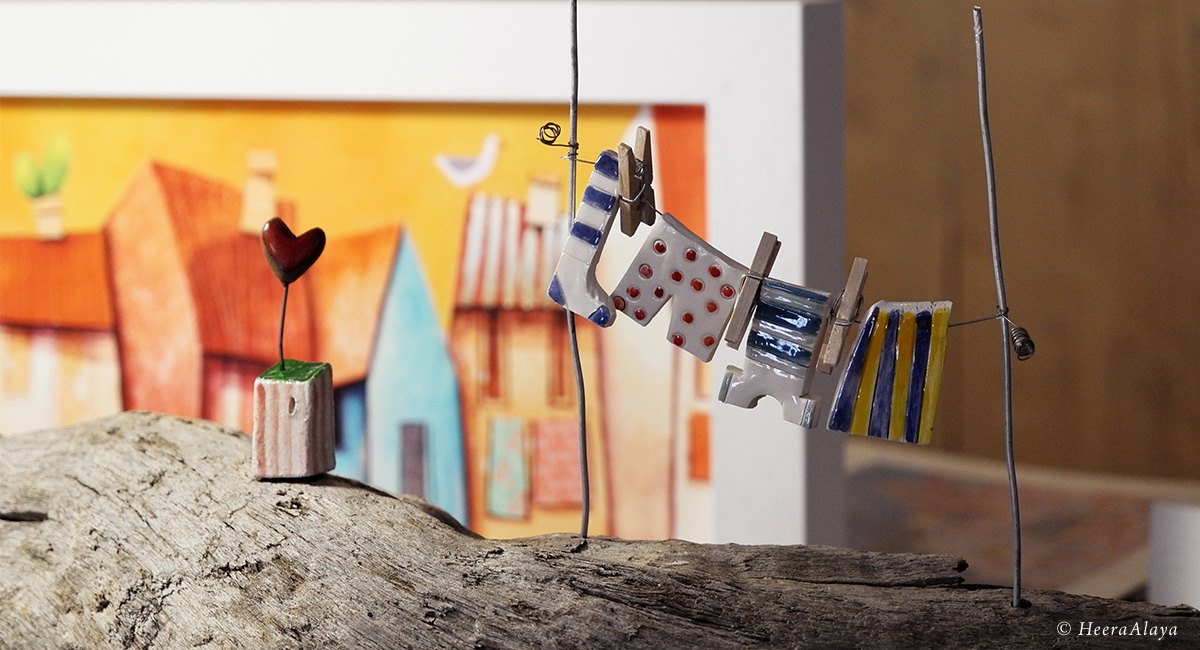
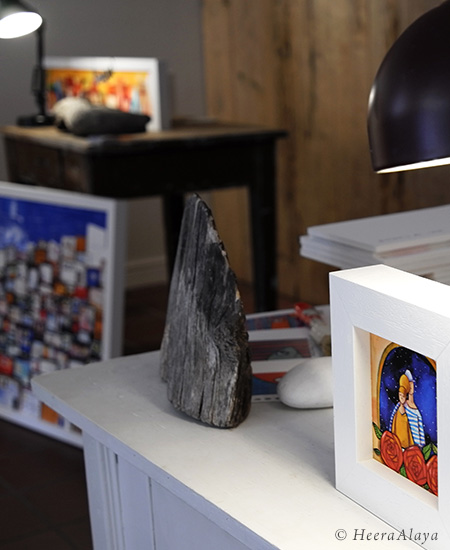
When did you move your shop and laboratorio to this location? It’s bright and inviting.
Thank you; this space is lovely. I have been here for a few months now. And though I have set up my laboratorio, I need to be in the flow to paint here.
My assistant is very good at running the shop, allowing me to paint from my home studio. However, I plan to work from here in the future.
Lucca is sprinkled with piazzas [Public squares], but Piazza Cittadella has a distinct atmosphere—it feels tucked away and is less crowded.
Sì. This piazza is hidden but still popular. Its unique charm comes from the fact that locals have resided here for 30 years or more. It evokes a feeling reminiscent of Lucca.
Do you paint from memory or based on photographic documentation?
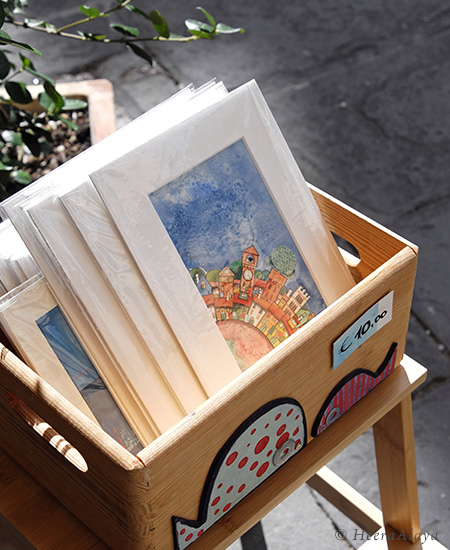
I prefer to paint from memory, as I like to capture places and moments that I recall. Occasionally, I take photos with my phone, like this one [points to a painting].
On what material do you paint?
I purchase wooden frames and paint directly on them.
Do you have to prep the wood boards?
Sì. I apply a primer to the wood board, a mixture of chalk, glue, water, and segale flour.
[Maria invites me to touch the board.] It has a grainy texture.
Si. I apply primer to the wood several times, and once the surface dries, I use oil paints to create my artwork.
Do you work on multiple canvases simultaneously?
Since I work with oil paints, I have to wait for them to dry. Occasionally, I will do some sketches. When inspiration strikes, I often begin several pieces at once.
Is there a specific time of day when you feel most inclined to paint or create art?
I find solitude with my thoughts in the mornings and late at night, which makes these times ideal for me. The ambience was the best (when I was) in the countryside; I long to recapture that feeling of being surrounded by trees.
You love the sea too.
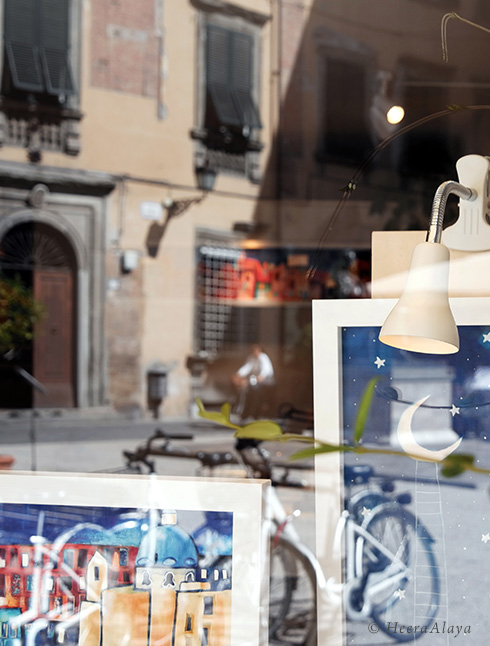
Sì. I love the sea. You’ll notice that blue is a prominent colour in my shop.
I also notice hearts.
I love hearts for sculptures.
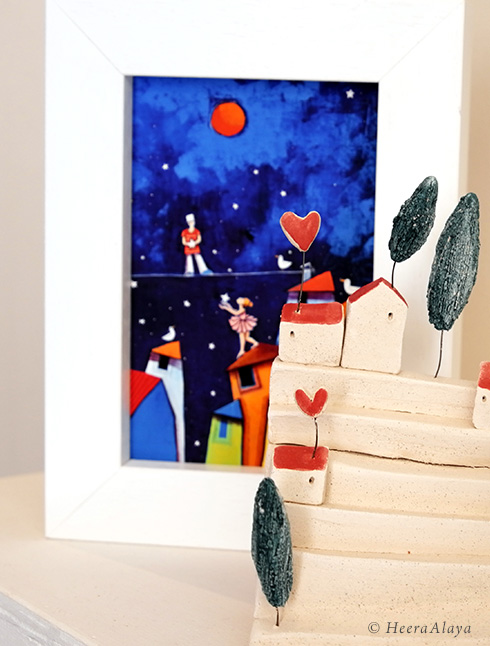
Where did you learn to make sculptures?
I am primarily self-taught. I also trained under a professor who had many students in his class. I read extensively and constantly strive to enhance my skills. My journey is one of continuous learning.
What do you enjoy doing when you aren’t painting or creating sculptures?
At times, I like staying home with my daughters, doing nothing significant—just waking up in the morning and taking care of the home. These moments allow me to recharge and return to my painting with a fresh perspective.
Your shop sells only your artwork. How do you maintain inventory?
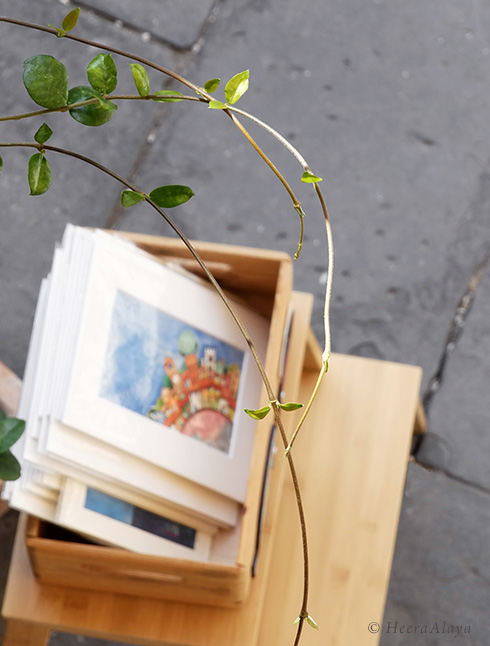
I also sell prints [in addition to her paintings]. But sometimes, I need to be alone and take a break. When I return to painting, I do so with a renewed mindset, which ultimately benefits my customers as well.
You must feel great satisfaction when customers purchase your artwork.
Of course, while selling my art is rewarding, what truly brings me joy is when someone like you walks into my shop, appreciates the details, and experiences a sense of well-being. Creating is not solely about transactions; it’s also about the joy I feel when people engage with my work and explore my collection.
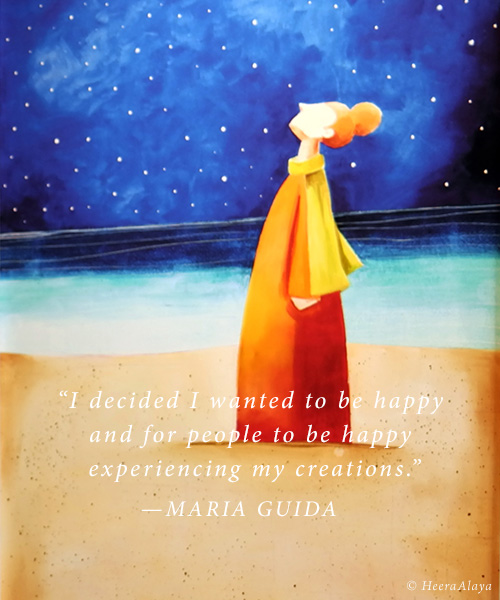
Once I was able to dedicate myself entirely to painting and sculpting, I decided to take a leap of faith. I decided I wanted to be happy and for people to be happy experiencing my creations.
There’s a beautiful reciprocity at play—we, as clients and visitors, resonate with your positive intentions and spirit, which deepens our appreciation for you and your work.
Brava. Brava.
What inspired you to start painting?
[Laughs] It was during my second relationship with a man from Lucca. He wanted me to take care of everything around the house—pick up the girls from school, manage the bills, and always look impeccable! And then, quite unexpectedly, he ended up with a woman eight years my junior.
Maria, I empathise with your situation. While I don’t wish to stray from our conversation, it’s essential to take a moment to consider the impact that a despicable man—someone who does not embody true manhood—can inflict on the well-being of a woman.
I read betrayers are part of the plan, and I believe this to be true. The universe places an inadequate male in the path of a quality woman, where his shortcomings and jealousy diminish her inherent qualities. Once the universe’s objective—to remind a remarkable woman of her potential and brilliance—is fulfilled, it often leads this inferior man to partner with someone of equally low caliber, someone who resembles his mother and is willingly submissive and dependent.
From an early age, a misogynistic mother’s influence can prevent her son from growing into a high-value, knowledgeable, and self-assured man. Instead, she ensures her weak son feels validated only when he is with an inferior, subjugated female.
In contrast, only a strong, quality woman can nurture a secure, enlightened, and worthy man—one who recognises the value of a high-calibre partner. This independent woman shines emotionally, intellectually, and professionally. Such a quality man will cherish, support, and celebrate your growth as a person.
Brava, Heera, brava.
Coming to you specifically, I want to highlight that, in addition to being a talented artist who creates uplifting and whimsical art, you are truly a stunning woman. You are blessed with freedom, peace, individuality, creativity, joy, and more. The world is fortunate to have you. Thank you for your journey, for rising, and for shining brightly.
Thank you so much. Initially, I was traumatised, but then I didn’t care, as I had everything I wanted: my daughters, my work, my assistant, everything.
Painting wasn’t my first job; I had another full-time job prior. That unpleasant experience motivated me to seek more independence, so I worked diligently and organised myself to become an artist.
[We high-five] Bravo.
I crafted my journey with my own hands. I was the only one who lifted myself.
Maria, this is the best approach—to rise on your own without owing anyone credit.
Sì. The best.
The cruelty and jealousy of others play a crucial role in discovering your independence and creativity and in reclaiming your light.
[Laughter] Sì. Sì. His [referring to the ex from Lucca] actions made me change my life to become the best I could be. I was very young.
You can’t turn back the clock on your age, but you can turn other aspects of your life around for the positive. Every experience gives you a chance to be better.
I also have to thank my last job as a cashier at Penny Market [supermarket chain]—it sucked. I was willing to risk anything for a better future. This space [referring to Maria’s laboratorio] has transformed me; I longed for a place like this to reflect my work.
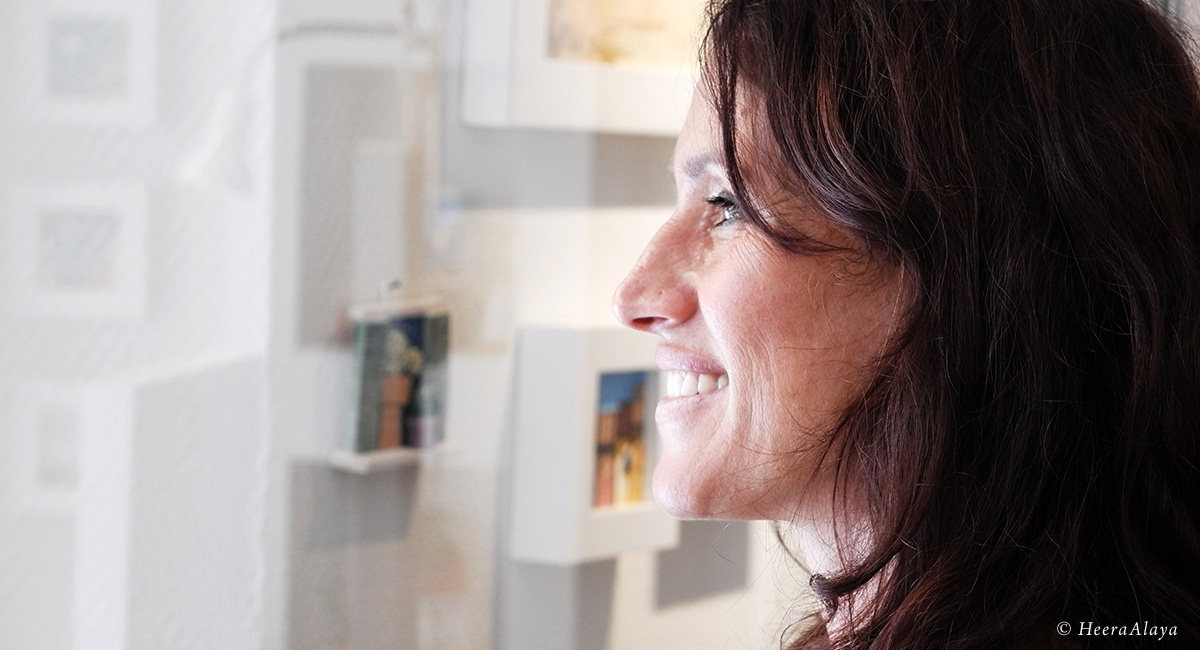
I appreciate the thought and effort you put into your work and space. You take the negatives and silently turn them into positives.
Thank you. It [Maria’s shop] is magic. And yes, work quietly because the energy of others can hinder your growth.
What is it like for a single woman, a divorcee, to manage her life in Italy?
In Italy, it is challenging because the culture is macho. And also, there is not much respect for a woman—because you are a woman. You can be a good mother, but you still have to do everything and be a certain way.
I do not have any help from my last relationship [the Lucca ex]. His attitude is: This is my daughter, but you are the mother, so you have to do everything. I will be here every 15 days to visit. I wouldn’t say I liked it, but I accepted it.
This regressive and chauvinistic mentality prevalent in Italian culture bears similarities to the Indian psyche.
How so?
Most often, the role of an Indian wife—despite textbook education and employment—is primarily confined to that of a full-time domestic caretaker or glorified housekeeper. While the wife succumbs to stress and resentment, the husband takes the credit: “My success, my child, my house, blah blah.”
[Laughter] This is familiar. In Italy, after everything a woman does—from housework to child rearing and from cooking to medical care, the wife has to work. A woman who doesn’t work is a burden to the man.
From my experience (which may not be representative of all women), the situation in the north [of Italy] is worse than in the south. In the south, families often have many children, making it difficult to indulge each one. Also, unlike in Napoli, men in Lucca often tell sex jokes and use inappropriate language, which demonstrates a lack of respect for women. In my observation, there is generally more respect for women in the southern regions.
How do you maintain your wellness and femininity amid face of hostility?
Recently, I haven’t had much time to focus on my well-being. However, the best thing I do for myself is eat correctly, drink water, take vitamin supplements, and lead an active life—walk whenever possible and bike (it feels like a perpetual holiday when I ride). Sometimes I eat terribly; I love cake, pasta, and pizza (my sister has a pizzeria and makes delicious pizzas).
The key is to capture the essence of life while remaining true to yourself and taking care of yourself. I lead a quiet life to feel inside and take in the goodness.
Learn more about Maria Guida.
THE MARIONETTISTS
The master manipulators
BEING A BEACON
emblematic of my essence
TAINA BIEN AIMÈ
“What was her life’s journey?”
DR VANDANA SHIVA
knowledge in women is threat
THE MARIONETTISTS
The master manipulators
BERNADETT TUZA RITTER
A Woman Captured
GENE BAUR
President, Farm Sanctuary, USA
“The veal industry was created to use unwanted male calves born on dairy farms.”