HEERA ALAYA
OFFICIAL WEBSITE
IN CONVERSATION
“You can get the happiest family living in great poverty,
but they have an emotional richness that carries them through life.”
KATE BLEWETT
Documentary Filmmaker, UK
February 14th, 2011
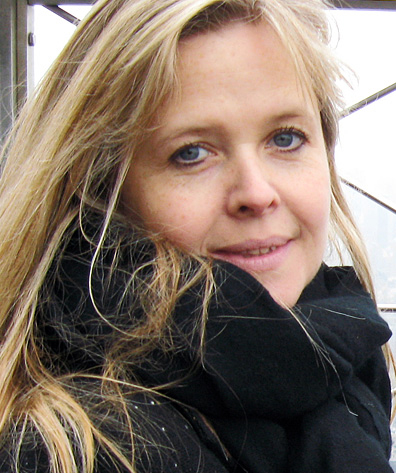
Documentary filmmaker Kate Blewett specialises in human rights and social issues through her impactful films. Her notable works include Eyes of a Child, The Dying Rooms, and Bulgaria’s Forgotten Children. Ms Blewett has been honoured with prestigious accolades, including the Emmy Awards, BAFTA Awards, Amnesty International Media Award, and the Peabody Award.
Heera Alaya: Your documentaries—The Dying Rooms, Eyes of a Child, and Bulgaria’s Forgotten Children—address critical issues, compelling us to question layers of neglect within communities and governments. What drives you to produce documentaries of this nature?
Kate Blewett: The time arrived when I woke up to the power of television as a tool to communicate and bring greater awareness about exploitation and neglect. I made Dying Rooms, a film about baby girls in China who were neglected and dumped into orphanages because of the one-child policy. The families [of the girl child] preferred to have boys. Dying Rooms turned my life around.
I lived in Hong Kong then, with easy access to China, and I was in and out of China a great deal to do my research and work. When I finished filming Dying Rooms, which was incredibly difficult and emotional (and the editing was, strangely enough, even more emotional because you could reflect on what you had captured on film), the challenge was to present a powerful film that could bring about change.
While I was trying to make decisions in those early days, almost 20 years ago, I didn’t realise the power of television to convey a strong message, with a subject you could put across powerfully by presenting the facts.
What did you experience when you put across the facts?
When Dying Rooms went on air, I hoped people would respond to the film and help these children. I was unprepared for the overwhelming global response to this film. It was a saturation of all my senses when I saw this emotional outpouring from every nationality. The film was shown in 44 countries and seen by 160 million people.
You started questioning the suffering of people at a young age.
I did [question suffering]. I had a lovely childhood and was fortunate to grow up in many different countries: Singapore, Hong Kong and Malaya. Living amongst different cultures and experiencing different ways of life made me incredibly curious at a very young age. When I was about six or seven, we lived in a small town, and I realised that this big walled building was a prison with people in it, people who had committed crimes, who had done wrong. But I was determined to find out what these people had done wrong, why they had done wrong, what made people do wrong, who decided how to lock them up and for how long, and how one human being decides how to punish another. These questions about life—how we rule our world, between good and bad—started overwhelming me; in many ways, it was the beginning of a journey for me, and I think that has never left me.
So, travel and exposure shaped the way you view the world?
Yes, travel was my greatest education. Witnessing others’ lives—poverty, disease and death of children the same age as I, and seeing people struggling to stay alive when I led a privileged life—had a significant impact on me. I wanted to expose subjects with a very focused journey to bring about change.
You have collaborated with Brian Woods on several of your documentaries. What factors help in completing a project?
Brian and I started with The Dying Rooms, and we still produce and direct together. One of the key reasons Brian and I have remained united for the past 20 years is that, right at the beginning, we established that filmmaking wasn’t about credit; it wasn’t about who would produce or direct. We were in it together and would contribute whatever was required to complete the film. The key ingredient is to remove silly things like ego and see it as a team effort to make the best film for the subject we focus on, and, critically, a sense of humour.
How do you identify the subjects for your documentaries?
Very often, one film leads to the next. For example, while filming in China, we met several people, and quite a few were NGOs [Non-Government Organisations] who would say we will help you, but don’t forget some children are involved in slavery—trafficked into the country and out of the country. Several issues are raised repeatedly.
How do you decide what content to keep and what to leave out?
Some projects are very painful to watch. Packaging is essential to making films watchable; we want to stop people from switching off from painful things.
Is one subject more compelling than the others from the many you film?
Yes, there is, for a number of reasons. But first, every film I have made has been an emotional journey. Strangely enough, the film that had the most significant impact on me was Eyes of a Child, filmed in England—we focused on poverty in England and children growing up in poverty. It was not just material poverty but also spiritual poverty or poverty from lack of love, and these children weren’t being brought up; they were dragging themselves up. These incredibly unhappy children came to us while wandering around, meeting families and researching for the film.
Eyes of a Child affected me the most because I was chatting and interviewing the children in English. There was no longer the escape moment of the translated and the translation to the person you are interviewing. When I was, for the first time, talking to children as young as four, five, or six in English in the UK, I looked at them, and they were coming back with answers. These children were smart little cookies. You could feel the emotion building, and you didn’t want these children to cry or to be hurt, but you wanted to tell their stories. You want to know the truth: what was working in their life and what wasn’t. For that reason, eye contact and concentration with someone you are interviewing in your language greatly impacted me. To this day, I see those children’s faces in my head; everything is in their eyes; it’s excruciating.
I know what you mean.
What challenges must you overcome to film these stories?
First and foremost, your research needs to be strong and thorough. With television, you have only a certain amount of time at a particular place. Moreover, the budget doesn’t allow you to sit around waiting for what you want; you are always up against the clock. And there are times when you know that your interviewees fail to share their stories despite having a life story to tell because, having just met you, they are not ready.
Every subject we filmed is emotional, as it involves people’s lives, emotions, and unhappiness. So when we stand in front of them, trying to find out their story, we ask an enormous amount of each interviewee—man, woman, or child. And sometimes, we run late; I tell my cameraman or producer that we must wait. It’s essential to have patience.
Have there been moments when you felt alone or helpless while working on projects?
Yes, I often felt alone at the end of the day because the days were intense, and I didn’t have moments to think about anything other than the subject. Then you go to a hotel room, and it’s just silent and empty, and you feel the sadness of the interviews you were doing through the day, the week, or the weeks. There is loneliness at the end of the day when you focus on sad, evil, or abusive situations.
There was one particular time when I was incredibly frayed; we probably pushed the boat too far. Wherever we go, we are unannounced; we are undercover. We don’t have journalist visas; we are on tourist visas. We secretly document what we get, as honestly as we find it. If people knew we were coming, we would never expose the truth, and things wouldn’t change.
How emotionally trying are factors like sounds, smells and sights (while filming)?
If I take Bulgaria as an example, when I first arrived at Mogilino, the Institute in Bulgaria, I only remember the smell of bleach. I walked to the front of the building; it had paint on the walls, and everything looked pretty clean. Then there was the smell of bleach, which made me think they kept Mogilio in good shape. Now, the smell of bleach has an entirely different feeling for me. A staff worker approached me: “No foreigners here; you must go; you must leave now; you don’t have permission from the government.” But I insisted I had permission to be at Mogilino: “I am with an NGO from Bulgaria.” As we chatted, we went into different rooms where the children slept; the corridors smelled of bleach. But as I walked into the rooms where the children were sleeping and pulled back the covers, I looked at death. And that was incredibly powerful because I could smell damp, rotting flesh.
The children were alive because there was a small whimper—like a tiny puppy whimpers in its sheer misery. The skin was rotting on the children’s bodies, with marks all over them from bedsores; the children were yellow, and their teeth were rotten. That smell and the visual were incredibly disturbing because you are looking at a human life rotting to death, in a cot, in government care.
That contrast between the corridors of bleach and the rooms of death will never leave me.
Then there is Vasky, a child with a broken leg, whom I often feature in the film. When I first saw her, Vasky was lying in bed; she was so thin—emaciated beyond words. Vasky made some quiet noises and then spoke. I leaned over backwards because I didn’t expect her to talk; I didn’t think Vasky had enough life to speak, but she spoke, saying in Bulgarian, “I am hungry, and I want to eat something now, please.” This strong, little voice came out and humanised Vasky. She was not close to death; Vasky had life in her, and she managed to express it. Vasky’s voice has always stayed with me, as well.
When you are filming, the camera may not necessarily capture smells and sounds; sometimes, the microphones don’t pick up weak sounds.
Your documentaries have many compelling and gut-wrenching visuals, a few of which are etched in my mind: Stoyan, the little boy with skeletal legs, standing frozen, waiting to be picked up; Vasky, the young girl, being fed, food thrust into her mouth before she could swallow, and the Chinese baby girl, Mei Ming [her name translates to no name] left to die. Did you realise the impact of these images?
I wholeheartedly agree with you. These three images are the strongest in my head as well.
Mei Ming was my first experience handling a dying child, which, to see on television, read about, or photograph, is very different. I can’t describe what it feels like to be around the smell of death and the sound of death.
Mei Ming was a particularly difficult case for us, as she was the first child I was looking at who was dying. Filming Mei Ming die didn’t feel right, and I instructed: “Stop, stop the camera; this is wrong; this is wrong.” I made the cameraman leave the room, and I left the room saying: “We can’t do this because this is Mei Ming’s life, her dignity.” Then I stopped and took a few minutes and thought: if you don’t show Mei Ming, you can’t prove that there are orphanages and situations in China—Mei Ming’s death was not by accident—where children are deliberately put aside to die. We have to show the truth.
So I returned and got a hold of myself, and we filmed Mei Ming; it was one of the most gruelling moments of my life. With Mei Ming, what gives me strength now is that her death saved many lives in China—many people responded to her images, got up, and did something.
People got up because they were emotionally charged, just as you were, and in many ways, I think that’s the secret to getting people to react positively—to make them feel sucked in and powerful inside.
People need to find something compelling inside themselves and feel great anger about it, so they do something. And Mei Ming made many, many, many people deeply sad, and they stood tall and said they wanted to help: “I can’t bear the thought that others might be like Mei Ming.”
And that goes for Stoyan and Vasky in Bulgaria, where when people saw the images of malnourished Stoyan with his stick legs, there was a whole influx of emails saying: “I want to adopt Stoyan now; tell me where to get him now. How can we work it out? I want to get him now.” People wanted to help because the images deeply affected them.
Your documentary on Mogilino shows caregivers stripped of emotion. What makes these caregivers apathetic?
The caregivers at Mogilino inherit the feelings of the last caregiver. In Bulgaria, everything worked the way it did for many years, with a hangover from communism, and nobody would step out of line because it wasn’t worth it. Also, there was a hierarchy within Mogilino, from the director and the senior staff down. Moreover, everyone inside the institute was related—aunties, uncles, sisters, brothers and extended cousins. You have great-aunts in their 70s, and the youngest family member is 18 or 19, yet you don’t overrule the elders who are set in their ways and unprepared to change.
The caregivers would feed the children and then go off to watch soap operas, message friends, and smoke cigarettes, even though, as caregivers, it’s their job to interact with children and make them happy.
Does self-love enable us to serve others kindly?
Yes. I have filmed all over the world and have seen that staff who successfully produced happy children (who ran towards them) were kind. And maybe staff don’t even need to love the children, but they are kind to them.
Kindness gives a child a sense of safety and belonging. In many ways, kindness is a critical aspect of care.
If you are doing your job and have children, you may not be able to love another child or all the children you are working with, but you can certainly be kind, and kindness creates happy children.
In your documentary, Bulgaria’s Forgotten Children, Didi, who had autism, deteriorated rapidly. Didi went from reading magazines to rocking like the other institutionalised children. You said Didi’s deterioration was due to a total lack of stimulation. Vasky, who was bedridden, flourished after receiving better care, choosing her clothes, participating in gymnastics, and enjoying music. What lessons can we learn from these dramatic transformations?
All you need is kindness and care for children to flourish. Didi, Vasky, and Milan were abused and were from environments that weren’t the top end—lacking money and topmost specialists—but what they had were caregivers who cared for the kids.
In Didi’s situation, her boarding house included a school, and she received input from staff who recognised her potential and showed her how to do her work. So, all that is required in these situations is care. And Vasky had maybe 17 years of neglect, starvation, and unkindness in Mogilino. The carers weren’t professionals; they took time to care for Vasky, and you saw the dramatic change—Vasky was alive and kicking, going to the gym, and cracking jokes. I would never have believed that possible. And when people say, “Too badly damaged, they will never recover,” I am sure they will never wholly forget what happened in Mogilino, but they still can lead fulfilling, happy lives.
How did you feel when you returned to Bulgaria and saw the transformed lives of children?
Bulgaria is incredibly close to my heart, and Bulgaria’s Forgotten Children is one of the films that greatly impacted me. Unlike most films—where we have limited time because we are unannounced—I got permission to shoot at the Mogilino Institute for a week, a month, and nine months, and I went back nine times to film. So, I got to know the children quite well and got attached to them.
And even though there was a language barrier—most of the children there couldn’t speak anyway—there wasn’t one. There was eye contact and physical contact; the children came to recognise me and know my smell. I came to know the children and watched them deteriorate in front of me. I couldn’t walk away once I finished making that film.
Apart from pushing the government for change and speaking with various NGOs, TV networks, and UNICEF about children in Bulgaria, I founded Bulgaria’s Abandoned Children’s Trust to support children in Mogilino and other institutions in Bulgaria.
Who is more disabled—people inside the institutions or society on the outside?
I think those living in institutions with disabilities are much more severely disabled than they otherwise would have been if they were allowed to be in society, leading normal lives as they could within the boundaries of their disability. And I think those who are disabled in the institute become severely disabled, developing all the recognised institutionalised behaviour—self-harming, biting, walking, humming endlessly, shutting down, and cutting off. Therefore, those living in institutions are seen as more aggressive by people outside the institution, breaking out and hitting you when you walk into the room. We are guilty of putting them into those institutes and not giving them [the institutionalised] a chance to live an able life.
Why do people fail to acknowledge the brutality and appalling behaviour they witness in their homes and communities?
Every individual is different, and the genetics of one person, combined with their environment and whether they are loved or not, can produce a different kind of human being. Whereas somebody with the same conditions but a different genetic makeup can respond differently.
But you can’t deny the existence of abuse?
I think it’s an important point that you just raised. For example, currently, I am looking at a subject that involves child pornography on the Internet, and I cannot find a single ounce of myself that can begin to understand how people can abuse children in that way.
But then I have to teach myself that it’s much easier to hand it [abuse] out when a person grows up with abuse. Many abused people I have met say they have to fight against doing the same thing that was done to them.
So it’s typical for sexual, physical, verbal, or silent abuse to be passed down?
Yes, because the abuse is something the abused know, and abuse becomes a part of them. It’s complicated, but it gives you a glimpse of how people become who they become. It’s a complex argument—should the abused have therapy, imprisonment, or both? Should they ever be allowed out of prison, or should they never go to prison or get therapy? And I think these are tough, complex questions because what works for one person doesn’t work for the next.
We engage with businesses that harm children and adults in developing countries. How can we consume mindfully?
Awareness is critical to decreasing the number of exploited and enslaved people. Some products make considerable efforts to show they are produced ethically.
While filming in India, we worked with a family whose son had been kidnapped and locked in a carpet loom; he worked there for 6 years, producing carpets. Around the same time we were filming, an NGO was putting RugMark labels on carpets. RugMark is a symbol or proof that enslaved people have not made a particular carpet. RugMark was successful because each rug was produced on a registered loom with a RugMark seal. That means you can buy a rug knowing it’s free of slavery or exploitation. We are all aware of businesses—from shoes to clothes, jewellery to fireworks—where children are involved, and we have to create universal trademarks, like RugMark.
Almost every government puts up a facade to mask fundamental human rights violations. Does pressure for accountability come from outside the country?
It has been repeatedly proven (and, from my experience, is true) that governments’ most significant changes have come from pressure from other countries. Journalists within a country have said, “We have been trying to tell this story for years, but when you come in as a foreigner, and you tell the story, everything goes crazy in our country because a foreigner has exposed the story and humiliated the government globally.
Outside pressure affects a country’s government more than its people and journalists.
The least impact of all of our films was the UK film that showed children’s poverty—so many children don’t go to school, their dads are in prison, and their mums are absent. We asked our government: “This is England; what are we doing about this situation?” But we got no real reaction. Our greatest success stories have come from exposing stories in different countries, where we tell other governments that they cannot allow their children to die or be enslaved. It doesn’t matter who points out problems; governments shouldn’t be allowed to get away with it. Governments should stand up and say: “You are right; we have this problem. How should we solve the problem?”
In larger charities, bureaucracy and a lack of transparency often mismanage funds. Should organisations provide total transparency to maintain credibility?
One hundred percent; transparency is the way forward. Charities and non-profit organisations should publish all their accounts and plans online, explaining what is coming in and going out. Many horrific stories have occurred about significant and respected NGOs mismanaging money. Millions were donated, and suddenly there’s a scandal: X percent isn’t going where we thought it was; instead, it is going toward big bonuses and salaries.
Through your work, you bring about great awareness and social transformation. Is this the goal, or do you see it differently?
I specifically set about making films about exploited, abused, or neglected people. I will not consider filming any other subject as long as I remain capable, healthy, and working. And I would not make a film unless it had a specific reason to be made, to bring about a positive change.
There are many television channels and programs, but only a small percentage of solid, honest, raw, truthful documentaries. I am not saying that there aren’t other filmmakers who can make documentaries, but there are very few slots given to those films by broadcasters; they are not in the majority—they are in the minority, where I would like to stay. When used correctly, I think television can bring about social change and improve lives.
How does Kate Blewett nourish herself?
My family is interested in and proud of what I do, making me feel I am doing something worthwhile. Also, the love they show me and the care they take of me make me feel comfortable, secure, and safe; they recharge my batteries in many ways. And my dog is good to me; he comforts me when he knows I am sad.
I also have to take a break between each film (I feel mentally and physically rung out), so I start doing basic things—cleaning my clothes, my shoe closets, and my food cupboards.
Cleaning feels so good!
Oh, I can’t tell you; cleaning is my therapy. I love going through my old photo albums and letters (from my father, who died) and reliving all my memories to remind me of my family—my background, what we have seen, and what we have done together. I get enormous nourishment from doing as little as possible, existing at home without the phone or the computer, with my family around me.
At the start of our conversation, you spoke about the documentary you filmed in England, The Eyes of a Child, and how it wasn’t solely about economic poverty but children’s emotional poverty. You are among the very few people who understand and value emotional wealth.
For me, it’s [emotional richness] obvious—you can get the happiest family living in great poverty, but they have an emotional richness that carries them through life.
BEING A BEACON
emblematic of my essence
EUDAIMONIA
amalgamations and elucidations
SONAM WANGCHUK
as you teach, so you grow
RECLAMATION
owning my narrative
TAINA BIEN AIMÈ
“What was her life’s journey?”
ROI DES RATS
Victim Impact Statement
GENE BAUR
President, Farm Sanctuary, USA
“We have done many terrible things throughout human history, and we have come up with reasons or beliefs that enable us to live in violent and cruel ways.”
© HEERA ALAYA ALL RIGHTS RESERVED