IN CONVERSATION
“Outrage is essential to fight injustice.
If I encounter injustice and I can make a difference, I feel a responsibility to act.”
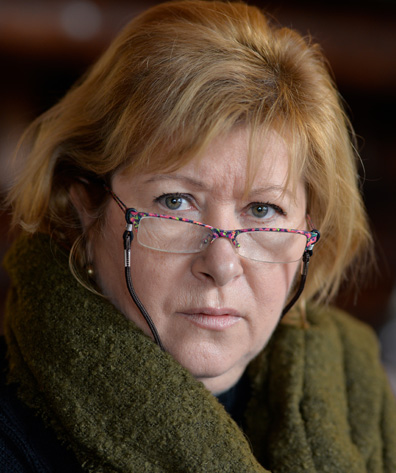
IANA MATEI
Activist and founder, Reaching Out Romania, RO
August 28th, 2022
Iana Matei, a Romanian activist and psychologist, is the founder of Reaching Out Romania, an organisation dedicated to identifying and rehabilitating victims of forced prostitution. Matei’s life is marked by a steadfast commitment to supporting and guiding rescued trafficking victims toward a brighter future. Among other honours, Matei received the “Hero of the Year” award from the U.S. Department of State in 2006.
Heera Alaya: You mentioned, “Trafficking is a consequence of unloved children.” Could you elaborate on the pre-existing vulnerabilities that make individuals more susceptible to trafficking?
Iana Matei: I can speak specifically about Romania. Unlike children who experience love at home, children from dysfunctional families and juveniles left in the child protection system don’t experience love. Therefore, when a young man tells them, “I love you,” these vulnerable children immediately believe the trafficker and are effortlessly recruited. The “lover boy” method has been the most effective recruitment strategy for the past five to seven years.
How young are the victims of trafficking? Are these victims primarily female or male?
Trafficking victims can be both female and male, but our organisation focuses exclusively on girls. In our shelter, our safe house, the youngest victim is ten.
Where are trafficked individuals sold?
In our case, all Romanian female victims are sold into the sex industry, while the boys we work with are also exploited for the same purpose.
Are transgender individuals also victims of trafficking?
I couldn’t say, as we don’t have any case.
You mention the “lover boy” strategy employed by traffickers. At what point, if ever, do the victims realise they have been misled?
This is a very good question. Remember, these children come from dysfunctional families or the child protection system and have experienced ills of all sorts—physical, emotional and sexual abuse. These abused children are used to abuse, so they don’t see their abuse in the manner we do.
I know what you are saying, as I relate to these abused children.
How does the cycle of abuse intertwined with gifts create confusion and dependence on the trafficker?
These children have been hit before. Each time their trafficker hits them, they often offer a lollipop as a form of manipulation or blame the victim with statements like, “Look what you made me do [hit the victim].” The trafficked victim learns that she must work harder or comply with every demand of the trafficker. And she will do whatever is required of her because she is dependent on her trafficker to gain approval and affection.
Is a trafficked victim isolated?
Victims of trafficking are often isolated. And when they socialise, it’s not with whomever the victim chooses—trafficked girls have to engage with whomever the trafficker decides for them. Trafficked girls are also kept together because the older girls train the younger girls to be more obedient by sharing experiences: “My boyfriend is like this. My boyfriend is like that.”
Where are traffickers looking for victims?
[Traffickers look for victims] Mainly in the child protection facilities.
So, orphanages and care homes?
Yes. Traffickers also target schoolyards—they plant their recruiters in schools, and these guys stay there for extended periods. These recruiters engage with children during recess, initially facing little response. But after seeing the same individual in their schoolyard for, let’s say, a month, the children become familiar with them. At times, a girl might respond, leading the recruiter to invite her for coffee or juice. Traffickers and recruiters possess a keen understanding of psychology; they can read body language effectively to identify who to approach and how.
Once a trafficker identifies his target victim, he knows how to present himself as the Prince Charming on the white horse, riding into the woods, protecting the girl [victim who is eventually trafficked]. This fairytale is a narrative that appeals to vulnerable children, as it represents a life they long for but do not possess.
You discuss the pervasive sense of fear that traffickers instil in their victims to facilitate their crimes. Could you elaborate on this?
The trafficker manipulates his victim—according to his victim’s obedience—by feigning love or conveying the absence of it: “I don’t love you anymore.” Additionally, traffickers employ guilt to reinforce their control, suggesting how unloved he feels when she doesn’t respond to his requests: “I have the impression that you don’t love me. If you loved me, you would do this [the trafficker’s demands].” So, the brainwashed-trafficked girl will go to extremes to prove her love.
Romanian victims are trafficked primarily into the United Kingdom, Italy, and Spain. What factors contribute to these trafficking routes?
While Romanian victims can be found in every country across Europe, trafficked victims are concentrated in the UK, Italy and Spain. Traffickers relocate their victims according to the seasons: in summer, they take their trafficked victims to Spain and Italy because there are many tourists. In the autumn and winter, traffickers move their trafficked victims to England or Belgium because they have apartments.
Are the trafficked victims compelled to work in strip clubs and massage parlours?
In Spain and Italy, trafficked individuals are primarily forced to work on the streets, although some are also made to work in massage parlour’s.
How does implementing legislation benefit vulnerable victims?
All European countries must have uniform legislation because traffickers in Romania recruit victims in Romania and transport and exploit them in other countries. This calls for coordinated investigations across borders.
If you can believe it, Romania currently lacks a minimum age of consent. Also, paedophilia is not defined in the Romanian legislation, making things more difficult. For instance, if a 13-year-old girl consents to sexual activity, she may not fully comprehend the implications of her decision. Despite this, a judge might rule that she agreed, and her assault may not be classified as rape due to the absence of a minimum age of consent. We are actively lobbying for the necessary legislative changes
Why does Romanian legislation lack a minimum age of consent and a definition for paedophilia?
The answer is straightforward: there is no political will to change it. We tried, lobbied, and brought in psychology experts to establish a minimum age of consent—to set it at 16 —but some mysterious appeal came through, and they agreed that the minimum age should be 14!
Shocking.
Yes. Politicians love young girls: the younger, the better.
Is this the reason why the number of prosecutions remains alarmingly low?
Absolutely. Human trafficking is a crime characterised by high profits and low risks, and we have maintained this status quo. We should strive to shift the balance to high risk and low profit.
Authorities do not confiscate traffickers’ money. The sentences are three years or three months, depending on what the prosecutor wants. This issue isn’t limited to Romania; for instance, in Belgium, penalties can range from a mere 400-euro fine—a trivial amount, considering traffickers typically have significant resources—to three or four years of imprisonment.
It’s ridiculous.
Exactly.
In India, the caste system worsens vulnerability, particularly for those in the lowest caste, who are already marginalised and more susceptible to exploitation.
Yes, I know.
To what extent do cultural practices and corruption facilitate crimes?
A trafficker has a higher success rate by targeting girls in a poor community because he presents a beautiful story with a bright future, which everyone wants.
While cultural practices may not be central to trafficking, corruption certainly plays a significant role. And I am not saying this only for Romania. Trafficking and corruption are a perfect match because, unlike trafficking drugs, where you have only money to gain, in human trafficking, you also have young girls. And for politicians, in addition to capital, they get young girls.
As an activist, how do you earn the trust of trafficked women?
I don’t think I’ve fully earned their trust, but I strive to be there for them through both good and bad times. Victims are accustomed to people turning their backs on them. It’s important to understand that they may exhibit behavioural issues as a result, which often leads to judgment from society. I openly discuss this condescending attitude with the girls; while it upsets us, we choose to move forward.
I may not be entirely sure how much the girls trust me, but they know I am always there for them. They see me as a pillar of strength, and that helps them. We frequently maintain contact with the girls long after they leave the program. I encourage the girls to stay in touch with me because I want them to know that I care for them and that what I do is not just a job. Many of my rescued girls are married women with their own families and children. And now they express that the support I provided has made a lasting impact on their lives. I am not aware of what I did then; I acted out of my commitment to them.
What is the starting point for rehabilitating victims who are clueless about life, living and the world?
Rehabilitation begins with the fundamentals. We provide psychological and legal counselling and teach basic life skills, such as brushing their teeth, taking showers, and caring for themselves. We explain how to dress and how to present themselves. We teach these step-by-step life skills every day.
The shelter’s social workers are introducing the rescued girls to age-appropriate relationships, which can be a cultural shock. Transitioning from one environment to another can be overwhelming, leading some girls to run away out of fear and confusion about what is expected of them. So, we slowly acclimate them to what we call a normal life, ensuring they have the opportunities and chances every child deserves.
Where does the greatest challenge lie in integrating women into society—working with rescued trafficking victims or addressing a society that often refuses to acknowledge the truth and trauma of these individuals?
I empathise with the rescued girls, who may display verbal or physical violence as a result of their experiences; they have faced abandonment and exclusion throughout their lives, making their reality incredibly difficult.
My concern lies with those in positions of authority. We have people who are supposed to be specialists in key places who don’t understand or want to understand and treat rescued girls like lost cases. This situation is deeply frustrating to me.
In society, we talk about trafficking and try to change the perception about these girls, many comments remain inappropriate: “They [trafficked victims] want it. Oh, she knew what she was getting herself into. Why did she need a boyfriend?” The reality is that the trafficked victim is often an adolescent.
How do you break the conditioning that causes victims to want to return to their traffickers, even after rescue and rehabilitation?
We are trying to do that [break conditioning] by giving psychological counselling and cutting all old ways of life, including severing ties with all the people from their past, which includes disconnecting them from individuals associated with their trafficking phase and taking away their mobile phones. They are permitted to use our phones to contact their families.
Your work encompasses rescue, education, and reform. Can you share more about your other initiative—lavender cultivation?
Since I started this project 20 years ago, we have never received government funding, as social projects in Romania often lack financial support. I was fortunate to have a good friend donate 50 hectares of land, allowing us to start a lavender farm. This project is conceived to involve the rescued girls. We allocate a piece of land to each girl and teach her how to run her own business. By developing and honing their skills, these girls can become entrepreneurs.
We currently have ten hectares of lavender from which we produce essential lavender oil, as well as candles and soaps. Without alternatives, we cannot protect girls or help them become self-sustainable.
Have the girls taken to lavender farming?
Yes. Some girls love being in the lavender fields all day, while others enjoy candle making, painting glass holder holders (for candles), soap production, and lavender bouquet arrangements. It’s all about nurturing their talents and empowering young girls.
Do you sell your lavender products online?
Yes, we do sell online. Most people in Romania place their orders on WhatsApp. Anyone can order through our website and our Facebook page.
What leads people judge and reject victims?
Judgment and rejection often serve as defensive mechanisms. Human trafficking is such a horrific crime that it demands action. And because this crime is too complicated, we say: “That cannot happen.” This denial allows us to avoid taking responsibility.
When you acknowledge: “Yes, this [human trafficking] crime exists; it’s terrible, and I have to do something about it,” you suddenly have a problem in your hand, and you have to solve it. So it is easier to dismiss, “This crime can’t be solved,” or “Someone else will take care of that because I am not a specialist.”
Our judgments and rejections also stem from a fear of failure. We tend to associate our failures with these girls, and we don’t like it. By failing to help vulnerable children, for example, and by shifting the blame onto them, we protect our peace of mind and self-image.
How can the younger generation be of help and find purpose?
I want people to look around because there is always someone in need. Take a moment to reflect on what resides in your heart; the “golden nugget” of your potential is within you. Genuine happiness is unattainable if you don’t utilise that golden nugget. Whether it’s a desire to work with children, the elderly, or individuals with disabilities, true joy arises from the act of giving.
You fled Romania during the Romanian Revolution [December 16th, 1989 to December 25th, 1989], eventually returning to help three girls. What about this experience progressed to activism?
The plight of children. In 1999, I was approached by the Romanian police and asked to bring sandwiches and clothing for three young girls, aged 14, 15, and just shy of 16. They confided in me that they had been sold and bought.
It took me a while to understand what these girls were sharing with me. I struggled to understand how anyone could sell another person. What criteria do you use to set a price for a girl? Do you look at the physique, and do you consider her memories, emotions, and intellect when setting the price? Do you take her soul into account? Is selling girls just for your [traffickers] pockets and financial needs. I posed these questions to the girls multiple times, hoping for varied responses. I learned that each girl was sold for 200 lei [approximately 40 euros].
When I inquired about the next steps for these trafficked girls, the police informed me that they were free to leave and could file a complaint against their abuser. However, as the officers spoke with me, the girls signalled from behind: No. This small but significant action made me understand the severity of the situation: “If he [the trafficker] gets to know we are in the police station, he will kill us,” informed the girls. I learned that these guys were violent, especially Albanians; they had guns. This vital encounter began my journey of rescuing and rehabilitating trafficked girls.
Did these events compel you to move back to Romania?
I initially came to Romania for a holiday while working on a program for street children in Australia. While on holiday in Romania, I learned that there were no programs for Romanian street children. On return to Australia, each time I worked with street children, I thought: “What about the Romanian children?” I knew I had to come back to Romania to introduce programs that work for street children in Australia.
Do their parents ever look for them?
Some parents look for their daughters, while others are very ashamed to accept their daughters [trafficked victims] when they want to return home. Many families, like the wider society, do not fully comprehend how trafficking works and the trauma that these girls experience.
Family integration is not impossible. Parents with low education initially blame the girl. With family counselling—though it can be a lengthy process—parents begin to understand that their child has endured significant trauma and requires their support. Once parents and families grasp the reality, they are willing to accept their daughter.
You possess an inherent capacity for courage. Much like sunflowers that thrive in direct sunlight, have external experiences influenced your ability to grow and face challenges?
My life was transformed through experiences. In our case, the sun is every girl who changed her life. Their [rescued victims] tenacity and resilience are truly empowering. These girls have a future, and their determination inspires me to strive further.
How does your training as a psychologist contribute to your work? You mentioned previously that you don’t recall doing anything particularly special for the girls, but you have; whether they recognise it or not. Is this selfless service an intrinsic part of who you are, or is it partly a result of your psychological training?
It’s [serving without expecting] both an aspect of my character and something my training as a psychologist enhances. I chose to study psychology because I have a deep affection for people; had that not been the case, I might have pursued mathematics instead!
[Laughter]
True.
What drives an individual like you to dedicate themselves to more significant causes?
I am deeply committed to helping trafficked victims due to the profound injustice faced by these children. We have failed to protect these defenceless children, and now we are unjustly shifting blame onto them. Children are not at fault.
How is your son, Stephan, involved in Reaching Out Romania?
Steph [Stephan] is my anchor. From the very beginning, Steph has shown compassion for the rescued girls. When he was younger, 12 or 13, Steph was never upset if I returned home late after spending time with the girls. Instead, Steph would say, “I have a mom who loves me, but these girls don’t have anyone.”
Stephan is actively involved with me. He manages the farm, drives the tractor, weeds the lavender, and oversees the distillery.
Stephan is your right-hand person.
Yes, he is. When Steph returned to study in Australia, I thought he would fall in love with a girl, get married, and choose to stay there, where life is beautiful. However, he fulfilled his promise and returned to Romania, stating, “I am going to study and will come back [to Romania].”
That’s commendable.
You talk about being angry. Is outrage essential to fuel your actions? If yes, how?
Absolutely, outrage is essential to fight injustice. If I encounter injustice and I can make a difference, I feel a responsibility to act. If I don’t fight injustice, I will be no different from the person who commits the unjust action.
I struggle to understand why society often remains passive in the face of injustice. We have people, mothers and fathers, who must know a child’s helplessness.
How do you nourish and heal yourself continuously to disperse healing to the many lives that benefit?
I cry because my heart is broken. And then, I turn to my faith, which is my anchor. I am a Christian and constantly pray, knowing God loves these girls. I will keep pursuing my purpose. One day, the rescued girls may use all the education we give them in the shelter to build better lives. I also know you cannot help everyone; unless a person wants to be helped, you cannot help.
Learn more about Iana Matei.
ROI DES RATS
Victim Impact Statement
EUDAIMONIA
amalgamations and elucidations
BEING A BEACON
emblematic of my essence
CORONA DI ALLORO
wear your crown
RECLAMATION
owning my narrative
SONAM WANGCHUK
as you teach, so you grow
JO-ANNE MCARTHUR
Photographer for Animals, CA
“Most people usually assume that cows continually lactate; people don’t realise that cows are constantly re-impregnated, and their babies are taken away for slaughter so we can drink the milk.”