
IN CONVERSATION
“We have been brainwashed to choose uniformity partly because
a militarised mind thinks in terms of uniformity.”
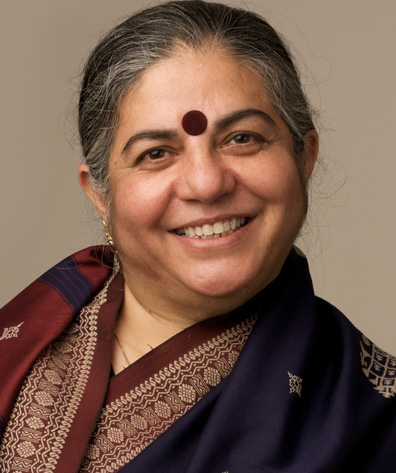
DR VANDANA SHIVA
Environmental Activist and Physicist, IN
March 8th, 2012
Dr Vandana Shiva, an environmental activist and champion of food sovereignty, co-founded Navdanya, a non-governmental organisation dedicated to promoting organic farming, seed preservation, and biodiversity conservation. Dr Shiva is a vocal critic of genetically modified crops, the erosion of farmers’ rights, and the impacts of globalisation. Among her notable publications are Soil Not Oil: Environmental Justice in an Age of Climate Crisis and Who Really Feeds the World?: The Failures of Agribusiness and the Promise of Agroecology. Dr Shiva has been honoured with several awards, including the Right Livelihood Award and the Sydney Peace Prize.
Heera Alaya: Dr Shiva, how does economic growth affect food production?
Dr Vandana Shiva: Economic growth is measured only in financial transactions—the more economic growth occurs, the more fertility is extracted from the soil, and the more biodiversity is replaced by monocultures. Commercial agriculture is about commodity production, which requires monocultures. Because monocultures rely on industrial systems, they use chemicals, fertilisers, and pesticides, which further degrade the biodiversity of our pollinators and soil organisms.
These monocultures also severely impact our forests—the Amazon is being cleared to expand soy commodity production, and Indonesian rainforests are being cut down for palm oil production. So, at every level, economic growth, measured in terms of money flows, undermines biodiversity and ecosystem growth.
There is much discussion surrounding India’s economic growth, but it begs the question: who truly benefits from this progress, and who bears the burden?
First and foremost, the emerging oligarchs are benefiting from this growth. Wealth has become concentrated in their hands; the billionaires control one-third of the Indian economy. Never before has India had billionaires, and never before have Indian billionaires been counted on the top billionaires list.
Politicians are the second group that gains hugely, which is why we see all these scams. We have a telecom minister in jail, the Commonwealth Chief in jail, and another politician in jail for the cash-for-vote scam because the nuclear deal (which was pushed by the US nuclear industry through the US Government) with India could only be won by buying votes in parliament. And the man who served as a conduit is in jail now, but the people who paid the bribes are not. So those are the two groups that have gained.
Who has lost? The tribal has lost; the farmer has lost. Every day, I get a phone call from one part of India or another: “Please come here; another farmer has been shot dead. Please get over here; tribals have been arrested.”
We see in India that this economic growth has unleashed a resource war and a land war against ordinary people who want to make their living on a little piece of land, have never disturbed the world, and have never damaged the economy.
And now, these ordinary people are being treated like disposable people. If the current MOU [Memorandum of Understanding] for land grabs is considered, we will have 100 million displaced people in five years. Add to that 60 million who have been uprooted since independence.
We are talking about a massive uprooting of India and pushing people into destitution. At the same time, a few handfuls of people gain hugely by grabbing their land, water, food, and electricity—grabbing everything that should be a public and common good.
You say that farmer suicides in India first emerged as a significant concern around 1997, marking a notable increase in suicide rates among farmers. There are two key questions to consider: Why is 1997 particularly important, and how are farmers and the farming community impacted when global corporations pressure them towards despair?
First is the issue of the farmer’s suicide—from where is it coming? Indian farmers have never committed suicide. Farmers have been resilient and strong, but only because they controlled their own destiny. Today, Indian farmers’ fate is controlled by seed corporations like Monsanto, which come with things like BP cotton seeds, promise miracles, and promise they will become millionaires. The agents encourage farmers to mortgage their land to obtain new seeds on credit. The new seeds get new diseases, so farmers must also take pesticides on credit. And before you know it, in one to two years, the farmer gets into such deep debt that he knows he will lose his land; he commits suicide. I am saying “he” because men mainly go into town to get news about the new miracle seed. Women are the ones who find out that they are in debt the day the farmer commits suicide. So here you have widows, and the government figures are more than 200,000 since 1997.
So you have a widow who has lost her husband and land and is left with a debt and children to bring up alone. I also want to point out two interesting planted stories and studies. Monsanto planted a study claiming that women are reaping significant benefits from BP cotton—the genetically engineered cotton they introduced—and that more and more women are picking cotton in the fields. Cotton picking indicated slavery; it wasn’t considered a liberating job. And in India, if women work in cotton picking, it’s because they have lost their lands and are not growing anything for themselves anymore. The study of Monsanto says that, therefore, men are probably in the kitchen and bringing up children when Monsanto knows that men have committed suicide.
Interestingly, the other new study, planted a second time by Monsanto, was about suicides in two villages, but they were not suicides. Monsanto has millions of dollars for advertising and planted stories; no one will challenge them or check them. But you know, we check. The movements on the ground are checked, and we will issue a very detailed report about Monsanto’s manipulation of these two villages.
Would it be accurate to say that larger corporations manipulate information, sway public opinion, and utilise public relations for private gain?
Definitely. For example, Tata Steel, which is expanding its empire by acquiring land from tribals in Kalinganagar, killed 12 people. However, their advertisements have tribals saying how much they have benefited from Tata Steel. Every corporation, especially one in the natural resources sector, has its spin, and public relations has replaced facts.
What does the common person do?
The common person fights. Tagore [Rabindranath Tagore] wrote an amazing essay titled “The Robbery of the Soil,” which illustrates how our current economic system is fundamentally rooted in the exploitation of the earth. This [theft] is happening today; people are being killed; people are being jailed. There is only one option left for the ordinary person—fight.
Why do countries import food, and how do these imports influence their self-sufficiency?
One, you import what you don’t grow, which is what countries have done. After all, colonisation was based on countries coming to India because they couldn’t grow spices. And I often joke: poor Christopher Columbus landed on the wrong continent and called the native American Indians because he thought he was sailing to India to grab the spice trade.
We see forced trade based on dumping in the name of free trade. Dumping means collecting massive subsidies and billions of dollars, and using trade laws like those of the WTO [World Trade Organisation] to force countries to open their borders to dumping. We can see what it does just by looking at India and Mexico. India was entirely self-sufficient in corn, but it was forced to open its borders to subsidised corn being dumped. In the first year, two million farmers were uprooted. Today, Mexico is dependent on imported corn, which isn’t even suitable for its food because it’s used as cattle feed and doesn’t make good tortillas.
Soya oil was dumped in India. The international price was $150 a ton; the subsidy was $190. It wiped out our oilseed economy, and because they also use laws on so-called safety and sanitary measures, they shut down local processing. I calculate we lost five million farmer livelihoods and a million tiny processors that make virgin oil. We estimate that we are losing $25 billion in farm income in India due to imports and dumping.
Farmers are stripped of their land and the food that should rightfully belong to them.
Yes, food is stolen from the farmer by preventing the farmer from growing crops that give the farmer nutrition and a sustainable income.
And by replacing farmers’ diversity with monocultures of commodities, you also lose food on that level. But because these monocultures need chemicals, you steal food from the farmers by locking them into debt and credit. So, the farmer grows a cash crop like cotton and then sells all the cotton to pay back the debt. And the farmer is on this terrible treadmill of never having enough to eat. The third way food is stolen from the farmer is through the global trading system, which dumps subsidies. The rich countries give $400 billion in subsidies a year. If soya oil is dumped, and it was dumped in India in 1998, not only are the farmers who grow oilseeds in India, the mustard growers, and the coconut growers destroyed, but that entire economy gets wiped out.
How many hands does food pass through before it reaches our kitchens, and who makes the most profit?
Well, there are three kinds of food economies. One is the local ecological economy, like tribal economies or indigenous communities, where food is produced and consumed; these are the most sustainable economies. Unfortunately, they have been treated like non-production because you are not producing if you consume what you produce.
You have large, ancient economies like India, with huge distribution chains, but no one person in the distribution chain takes more than 2% (that has been the traditional norm). If a trader buys grains from the farmer, it’s two percent; then that trader sells them to another trader at wholesale. That wholesale trader sells the grains to retail, and at every point, it’s two percent. From our research, the difference between the farm price (what the farmer gets) and the price the retailer pays hasn’t been more than 6% until globalisation brought in the big players.
The big players pretend they are eliminating intermediaries because they are the only ones. The seed corporation has turned the seed into a commodity and intellectual property; they make huge profits. Every year, Monsanto extracts 10 billion Indian rupees from cotton alone. Can you imagine if every crop were genetically modified and patented? This industry has set an annual royalty income of $1 trillion. Then you have the global trading giants like Cargill, ADM, and CONAGRA. They make enormous profits by changing distribution systems, making third-world countries dependent on imports, even when they could produce enough for themselves. I had to file a case against wheat imports a few years ago when we were growing enough wheat, and instead of paying the farmers, the government, under US pressure, was being asked to buy from Cargill. We stopped that, but Cargill, of course, had its tentacles everywhere.
The next group to make huge profits is processors like PepsiCo, which turn potatoes into chips. Well, potato farmers were committing suicide, and analysis found evidence that farmers were spending 300 Indian rupees (the company supplies potato seeds and pesticides on credit) per 100 kilograms of potato and selling it at 30 Indian rupees per 100 kilograms; that’s one-tenth the price.
One packet of chips that sells for 20 Indian rupees gives the farmer only .08 Indian paisa—no wonder these companies are growing bigger and bigger. If you add these numbers and get vertical integration, the retail giants, like Walmart, are trying desperately to enter the country, pretending to prevent waste. Walmart makes it look like India is wasting everything. And I always say that in India, nothing gets wasted—you eat it; if it’s not the best quality, it will sell at a somewhat lower price, someone else will eat it, and if you can’t eat it, the cow will eat it, and if the cow does not eat it, it goes into the soil as food for the soil. Our calculations show a six percent difference between farm prices and retail prices is now an 80 percent difference, and it’s the multinationals collecting that profit.
Fertilisers and chemicals are assigned Indian names with positive connotations to mislead vulnerable farmers. What prevents governments from enforcing appropriate labelling?
The governments are part of the misleading. Pesticides should be called poison; in Hindi, it would be jahar [poison], but it is called dawai [medicine] in the official language. When it is dawai, it’s something that cures you, and of course, the multinationals are very clever in giving Indian names to most of their seeds and chemicals. Part of the problem is that when these corporations become as big as they do, they appropriate parts of government and start working for them. The government stops regulating pollution and becomes a promoter of spreading poison.
We are fighting a new bill called the Biotechnology Regulatory Authority Act of India. We have a strong environmental protection act and stringent rules for regulating GMOs [Genetically Modified Organisms]. The government would like to see its laws destroyed to give Monsanto a free hand—in effect, the corporations have hijacked our governments.
How do multinational companies manipulate the internal functioning of third and developing countries to sabotage local produce and introduce their products?
There are several ways multinational companies do it [play with the internal functioning]; it’s called lobbying. Lobbying is legal in the United States and illegal in India; in India, we still call it bribing. Walmart has just gone on record for paying 11 million dollars to try to get the Indian government, Indian officials, and an Indian economist to forge false documents to show that giant retailers are better than primary retail.
We don’t know how much Monsanto has spent, but they have spent a lot. They have grabbed a monopoly on the cottonseed supply and are now signing MOUs [Memorandums of Understanding] with every government and taking over all the tribal areas, which are sovereign in seed supply. Therefore, Monsanto is targeting areas where there will be no seed left, and those areas will also become dependent on their hybrid GM [Genetically Modified] seeds.
Multinational companies are replacing crops. For example, you had wonderful Jowar and Bajra in Rajasthan, which are highly nutritious; they’re being replaced with corn. In India, the corn they sell is not for human consumption but for animal feed. So multinational companies replace the foods and seeds of local communities, change cultivation patterns, and make farmers dependent on the purchase of seeds and the sale of produce. That is how monopolies get established.
Food trends are constantly changing, often influenced by the media and the medical industry. This raises an important question: Is there a connection between food corporations, the medical industry, and the media? Moreover, is there collusion among these industries to mislead the public?
The first thing to recognise is that today’s seed industry is the same industry that sells us agrichemicals—poisons, pesticides, and herbicides —and is also involved in pharmaceuticals. So, there is a very close and intimate nexus between these three sectors.
Agriculture that feeds agrichemicals creates disease to give you cancer, and you have the same companies that sell you toxic chemicals and toxic seeds. Then, Novartis is ready with patented drugs to cure you of cancer. A big fight is going on in India right now, where Novartis is suing the government because it does not grant patents for fake novelty—we grant them for real novelty. And they want to evergreen—refurbish an old drug and destroy the Indian drug industry.
The media is deeply involved; the Times of India published a full page of what looked like news titled “Reaping Gold through Bt Cotton.” It has now been discovered that Monsanto planted this article, and the journalist who wrote it posted it like an ad. This is called paid news, where the boundaries between advertising and news disappear because companies pay for news to be planted at advertising rates. Unethical media is only too happy to take this up.
Why are we constantly encouraged to rely on household cleaners, detergents, and pesticides that eliminate germs?
The toxic industry sells poisons and has made us afraid of the living world. Of course, the living world has bugs, but we have immunity to bugs. Of course, the living world has insects, but they balance each other through predator-prey relationships. They have turned the living world into a threat and the toxic chemicals into the solution. Whereas it’s the toxic chemicals we should be worried about and get rid of from our lives through organic farming, organic eating, and celebrating biodiversity.
The more biodiverse our world is, the healthier it is, the less dangerous bacteria and fungi in the soil, and the fewer diseases from food.
I quote you from Stolen Harvest: “In a complementary system of agriculture, the cattle eat what humans cannot. They eat straw from the crops and grass from pastures and field boundaries. In a competitive model such as the livestock industry, grain is diverted from human consumption to intensive livestock feed. It takes two kilograms of grain to produce one kilogram of poultry, four kilograms of grain to produce one kilogram of pork and eight kilograms of grain to produce one kilogram of beef.” Why do first-world countries attribute the increased demand for food mainly to predominantly vegetarian countries? Additionally, do cows in factory farms significantly contribute to greenhouse gas emissions?
Cows grazing on pasture don’t emit methane in the same way as cows on factory farms. Factory farming is implicated in climate change, greenhouse gas emissions, and creating hunger—70 percent of American corn goes to feed animals.
Because of the profits associated with factory farming, the First World is pushing it everywhere. Eastern Europe didn’t have factory farms, but they [the First World] pushed it into Eastern Europe. These factory farms become a source of diverting food from the hungry, a source of climate change, and a source of massive water pollution, as now all that waste is thrown into the groundwater and watersheds, and it’s becoming a significant pollutant, for which water-deprived people are fighting.
How is it that India, a nation that claims to revere cows, both trades and exports these sacred animals for consumption and economic development?
The World Bank published a report on the future of India’s livestock industry, stating that the idea of the sacred cow is a significant cultural impediment to its growth.
The economic interests are trying to dismantle the idea of the sacred cow and a non-violent farm economy.
Thankfully, I work on total ecological principles. But you know, when some local grown-ups try to save cows, immediately there is an accusation: “Oh my god, this is a Hindu enterprise,” therefore anti-Muslim, which is not true because, for the Muslim farmer and the Hindu farmer, that cow is equally vital for a sustainable economy. There is a massive assault on all the values that have provided organising principles for a sustainable India.
My work with Navdanya involves seed saving, organic farming, and the cultural defence of practices that allow us to live in peace with other species.
From which quarters do you receive maximum support, and where do you experience real change?
Most of my support comes from women, indigenous people, small peasants, and those living in poverty—the real forces of transformation.
The most notable participation and change come from the impoverished; however, the wealthy often pretend to participate.
Historically, there has always been an attempt to appropriate struggles and give them another direction and dimension. That’s why the excluded, the poor, must maintain the leadership of their struggles and define them on their terms.
What are your thoughts on public figures and companies that portray themselves as environmentally conscious, despite their lifestyles and operations being in direct contradiction to environmental sustainability?
We are reaching a severe crisis where this pretend green—talking a bit of green, and greenwashing—will not work anymore. The environmental situation is so critical that the earth’s authentic green and the struggles of the poor who depend on it will show the way forward.
This question ties into the larger context of human exploitation within the realm of extremely low-cost garments.
There are two levels at which textile becomes so cheap that someone can wear a shirt for one day and throw it away (because it’s costlier to have it cleaned or repair a button). First, we exploit the cotton farmers for the fibre, which is why the farmers commit suicide. The second is the exploitation of labour. Look at Walmart; they get very cheap jeans from China.
Is the human race becoming increasingly destructive?
It’s not the human race that’s destructive; it’s a tiny portion of the human race — the capitalist patriarchy—that’s destructive, and this portion controls the world’s capital.
The native inhabitants didn’t destroy the Amazonian forests—Cargill and the hydropower companies did. Women have not been leading agents in this destruction. A tiny group in powerful positions has tried to redefine what it means to be human. They have proven destructive, and we must reclaim our humanity to be creative, nonviolent, and at peace.
Why are we continuously brainwashed to choose uniformity when irregularities and uniqueness add to diversity?
We have been brainwashed to choose uniformity partly because a militarised mind thinks in terms of uniformity.
And the big industry is thinking through a militarised mind of violence and control. The second reason we are made to believe only in terms of uniformity is that it suits centralised control. Diversity requires decentralisation and democracy. Uniformity requires centralised control and dictatorship, and because they want to establish a food dictatorship, food uniformity is the ultimate instrument.
How can we make healthier food choices rather than being swayed by eye-catching packaging?
Don’t go for the cosmetic appearance because food is not cosmetic; it’s not a little rouge on your cheek—it’s food that will become your blood and has been extracted as blood from some community.
There are two ways to eat consciously. First, you have to figure out everything about everything you eat, which is very tedious. The other is to eat locally, where you know how the farmer grows the food. Food responsibility and freedom require knowing where your food comes from and how it is produced.
What advice would you offer to young people who face constant messages encouraging them to consume and discard without thought?
We have been given a very beautiful and very bountiful earth. Begin by recognising how much potential is being destroyed by our aggression and our pollution. Don’t become part of the destruction of the Earth. Make a conscious choice for the Earth and the rights of Mother Earth.
You talk about reclaiming knowledge. How can women reclaim knowledge when they cannot own their thinking?
The point is that a patriarchal system would like to shut women out, but women have not stopped thinking. All the movements I have worked on over the past 40 years of activism have been women-led. Women began the Chipko movement in the Himalayas to stop logging. Or when women of Bhopal were still fighting against the toxic pollution caused by Union Carbide, which is now Dow. So everywhere, women are very, very active.
In Navdanya, we have done two things: celebrate women’s knowledge and reclaim our knowledge. First, there is a movement called Diverse Women for Diversity. We fight masculinity for monocultures and monopolies, and we celebrate diverse women for diversity. Second, we run Earth University in Dehradun, on the Navdanya farm. Every year, we do a grandmother’s university, a course dedicated to our grandmothers’ knowledge, wisdom, and skills.
Your presence agitates men. Dr Shiva, is your knowledge a threat?
Oh, knowledge is considered a very big threat, and knowledge in women is a double threat.
Learn more about Dr Vandana Shiva.
OLIO NUOVO
custodians of culture
THE MARIONETTISTS
The master manipulators
FRENCH LAUNDRY
restoring your soul’s hygiene
TAINA BIEN AIMÈ
“What was her life’s journey?”
EUDAIMONIA
amalgamations and elucidations
THE BIRD BATH
holding space: a home to feel safe
JO-ANNE MCARTHUR
Photographer for Animals, CA
“There is no respect for animals on earth—animals are exploited for entertainment, food and wildlife. We hunt animals, and we encroach on their territories. We have hierarchies, and we place humans at the top, translating into animal suffering and death.”