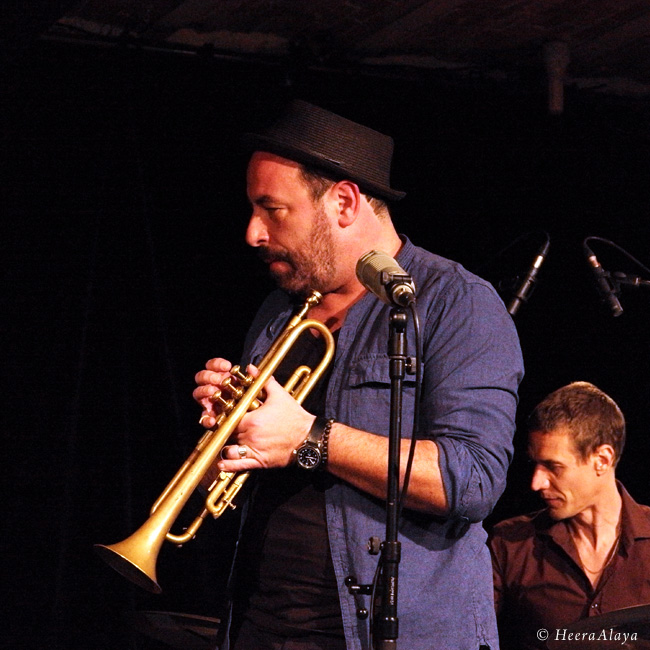
IN CONVERSATION
“Discipline and routine are important.
The more regular and methodic you are, the more it works.”
CHRISTOPHE LELOIL
Trumpeter and teacher, FR
February 29th, 2024
Heera Alaya: [Exiting the pre-concert rehearsal] It was a pleasure observing you during rehearsals. Thank you for having me.
Christophe Leloil: You are welcome.
Amid instrument tuning, sound checks and lighting adjustments, I observed the camaraderie between you and your band.
No, no, I hate them [his band].
[Laughter]
I don’t believe that! I get the impression you’ve been playing together for quite some time.
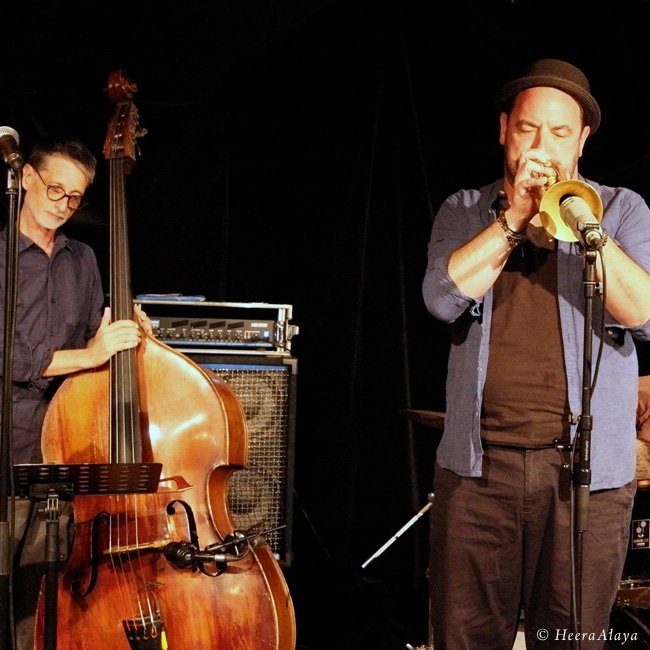
We [Cedrick Bec, the drummer; Pierre Fenichel, the bassist; and Andrew Sudhibhaslip, the guitarist] have been touring since the summer of 2020, performing at around 20 concerts.
What role does camaraderie play in your performances?
We should give camaraderie little importance. We are all professional musicians, so we don’t need to be friends. Musicians need to be good at what they do and engage in every situation presented to them. Of course, it’s cool to tour for a long time and experience a long journey. For example, Cedric [the drummer] and I have collaborated for almost 20 years on multiple projects and toured many countries. It is the same situation with Pierre [the bassist]—we have toured the United States, Armenia and Europe. We know each other; we have the same kind of humour, musical tastes, and media experiences—we agree on many things. This familiarity allows our performances to flow naturally and enthusiastically, as we are always happy to see each other and return to work together.
Do you find yourself missing the group [Cedrick Bec, Pierre Fenichel and Andrew Sudhibhaslip] when playing with different musicians, or does newness have its own energy?
Every musical situation brings different experiences. Sometimes, you go on tour with people for a week or two and find that you don’t like someone, but that’s part of the journey. There have been times when I’ve shared the stage with musicians, and the atmosphere was quite tense: “Oh man, I don’t like you; I don’t like the way you talk to me; I don’t like the way we are playing together”, but since we are all professionals, we have to manage.
Interestingly, that tension also influences the music in different ways. First, it’s a question of trust between each other, of listening to each other in different ways, and sometimes it works even if you don’t like the people. Since we play jazz, there is a lot of instant improvisation. You are surprised. Sometimes, you are even more surprised when you don’t know the people.
Ultimately, being able to play music, whoever plays music with you, whatever the piece, how difficult or easy it is or how sensitive it is, you still play. At that moment, the audience appreciates the music. There are times when you reach music at a high level, no matter who you’re playing with—you don’t know their experience, you don’t know their life—you are just receiving their sound, you are accepting their feelings, their skills, and that makes it work.
What is the small cup-like piece that you attach to your trumpet?
Oh, that’s a mute.
And what is the purpose of a trumpet mute?
A mute subdues the sound, altering it to a desired tone.
Why do you switch between using and removing it?
The mute helps me stay organised in that moment, allowing me to control how I want the sound to be and when I want it to take on a particular quality.
Your rehearsals go beyond just band practice; they also involve lighting and sound checks.
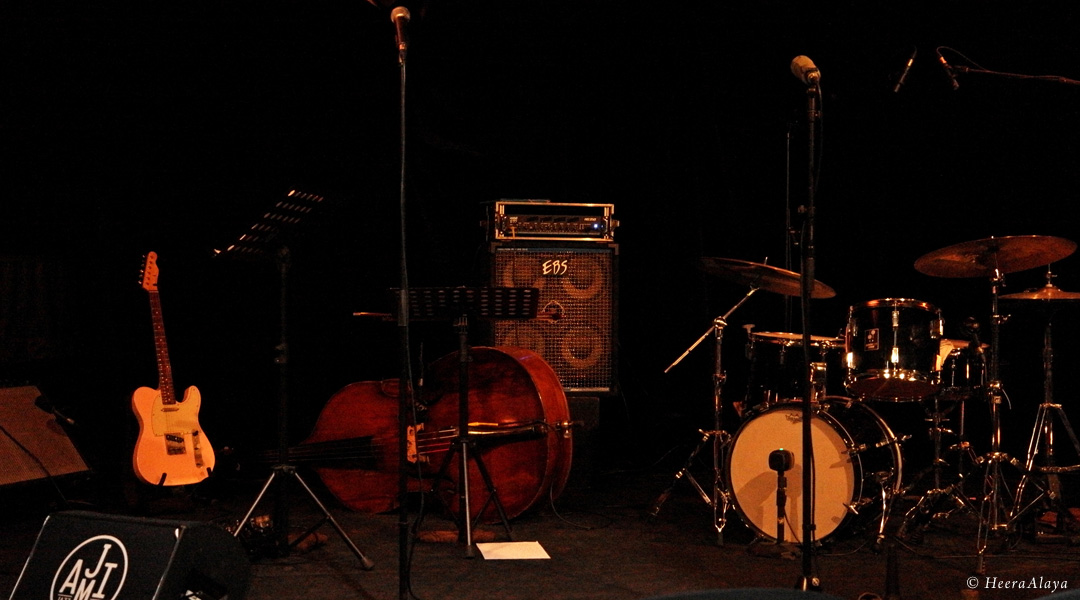
Exactly. When we arrive at the show’s venue, we mainly check the orchestra’s sound for the audience. It’s a time to ensure we have the stage sound just right. We keep it brief; we are not rehearsing (we have already done this beforehand), and don’t get cues. Once our sound check is complete, the crew can fix the lights.
I noticed you didn’t go to the stage right away. Instead, you sat down, went on stage, and then made your way backstage. You were moving around quite a bit.
For me (and for many), it is important for the orchestra’s rhythm section—bass, drums, and guitar—to connect. The three of them (bass, drums, and guitar) can experience each other, the sound, the space, and the lights and have a good feeling. After that, I go on stage to bring it all together.
Do you give only a small part of yourself during sound check rehearsal—to conserve energy for the central performance?
For sure. During the sound check, we aim to explore what works and what doesn’t. Then we have the stage, the audience. If you go 100% or even 80% during sound check, it can be like, “Wow, I love what happened,” but it won’t happen again. There is a lot of improvisation when you go on stage for a performance with the audience.
You mentioned collaborating with this group—Cederic, Pierre, and Andrew—since 2020.
In 2020, we were all based in Marseille and had the opportunity to perform at the Marseille Jazz Festival, for which I wrote the music. I have been touring with Andrew (the guitarist) for a while in a duet or trio setting, and I wanted to add something more. Julia [Julia Minkin, Singer-songwriter] was present, and I asked her, “Would you like to sing?” Julia’s singing and lyrics blew me away, and we formed a band organically.
We rehearsed for a few weeks before our stage debut. We were so happy with our performance and the mutual trust that we decided to continue together and record a CD. Then the COVID lockdown happened, and we used that time to fix any issues. We had two extensive rehearsal sessions over five to six days—getting into the music together—one before the first date and one before the recording date. It’s cool to have the opportunity to rehearse.
How often do you practice alone?
A short routine—an hour or two—on concert days is good for me. When you play too much, your lips can hurt, and you can get tired before the concert ends.
Discipline and routine are important. The more regular and methodical you are, the more effective it becomes. I focus on what I need to expand—speed, sound, etc.—and try to use precise exercises to get in touch with my discipline and more.
I am not the guy who takes his trumpet and blows into it like a fantasy, which occurs when you play with the audience.
Do you skip practice on days when you are travelling?
No. You have to organise yourself. Sometimes, you have a seven-or eight-hour drive or flight, so you won’t have the same time to practice. But if you don’t have time one day, make time the day after. It is essential to stay connected with the horn and with the music.
What do you do in situations when you’re unwell?
It depends on the instrument. For example, if you don’t play the trumpet for three days, it takes three days to recover—I need to recall my centre, my sound, and where I should be to perform naturally. Some musicians can take a week off and go back to performing. However, my off time and recovery time are the same.
Have you ever experienced pain in your hands or fingers?
No, but I do have back pain. I suspect it may be related to my posture. I am not a sportsman, as you can see [laughs]. I don’t deal with physical issues; I enjoy time, food and drink, trips, and life. I am fifty, and as I get older, I realise I should take better care of myself.
How do you hear your sound—do you record it and play it back?
It is a lifelong journey; you are constantly researching, developing your ears and sound, and creating the sound you hear inside with the horn.
Do you sense how your sound has evolved?
Oh yeah! Sure. The deeper you go into the journey, the more your sound reflects your true vision. When I play the trumpet, I hear myself; I don’t hear Mark Davis [singer, songwriter], Jeff Baker [pianist, composer] or Clifford Brown [jazz trumpeter. Pianist]. When you get to this point, you start to say, “That’s me, and I like it.”
You never totally arrive at a final destination—the more I play and practice, the closer I get to my ideal sound. Sometimes, you record yourselves to hear your sound; other times, you hear your sound through concerts (most of which are recorded). I notice significant changes if it’s been 4 to 5 months since my last studio session.
You may be sick or tired; many things make you feel differently. I can’t predict what will happen tonight [the night of the concert] with my horn.
Are on-stage theatrics an essential accompaniment to your musical craft? How do you inject your personality into your performance?
Wow, that’s a good question. Performance is indeed essential. We are on stage; people are watching you and hearing you. It is often said, “The best way to hear jazz is to watch it,” and I agree with it. If you listen to what happens, you can bring the music to a very complex level at many points. Most people will say, “That’s too much; I don’t get it.’ But when you observe the interaction among musicians—the piano player exchanging glances with the drummer, the bass player’s nimble fingers, the trumpet player pouring out sound—you can elevate the music to a more complex level. Witnessing these interactions adds a layer of understanding, making the music feel more natural. So yes, performance is crucial.
[Laughter]
Do you have a pre-concert ritual, perhaps enjoying a beer or two?
Sure. Maybe two or three [beers].
[Laughter]
We used to have a ritual with other bands—have strong shots of whiskey before getting on stage. And why not? I know people who need different forms of drugs to get on stage, and I know people who don’t need anything.
And others have lavender tea!
Yeah.
[Laughter]
Whatever rocks your boat.
Yeah, whatever works for you. You need to deal with the emotion, stage fear—
Do you have stage fright?
Stage fear can vary depending on the circumstances—a new project, performing in a large venue, travelling frequently, or simply being too tired.
At what point do you have to conquer stage fright—after seeing the audience’s reaction or stepping onto the stage?
Confronting stage fright occurs before you take the stage. Once you’re up there, it’s too late to reconsider. And then, when you are on stage, there is so much energy that even if you are tired, you forget your headaches and backaches, the adrenaline kicks in, and the music flows into you.
How do you unwind after a performance?
I enjoy interacting with the audience and hearing their impressions and emotions. Even if you receive applause or if people are happy to be there, it is essential to have feedback. When you return home, you reflect, “Okay, I’m exhausted, but I have to work on this feedback.”
How do you improvise your sounds?
There is a lot of background—what I heard, what I have studied throughout my career, and the influences that have inspired me. You collect this information and try to make music your way. And you spend most of your life improvising.
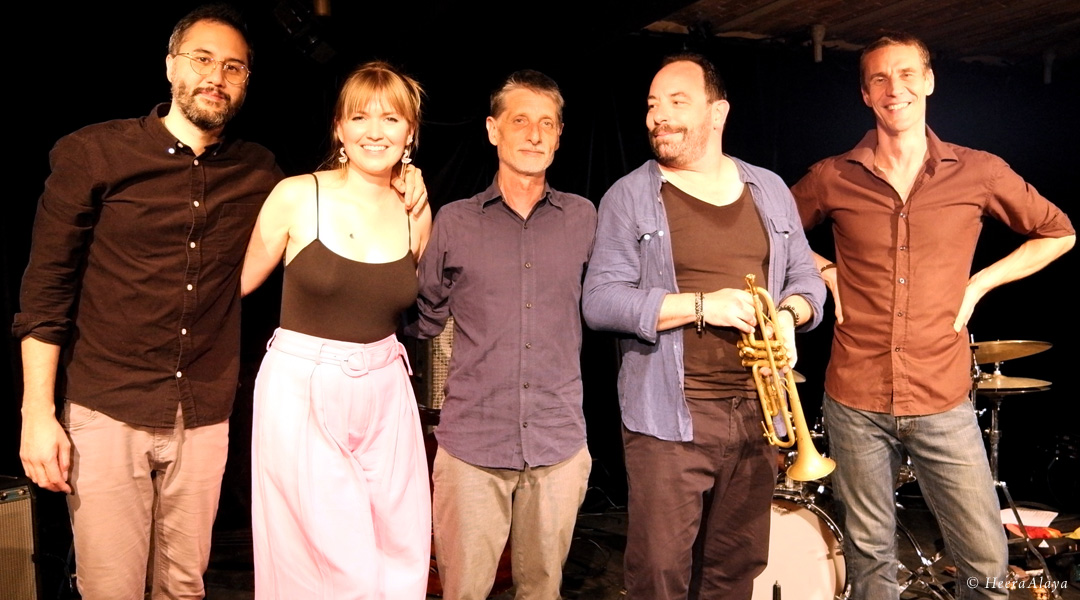
From left: Guitarist Andrew Sudhibhasilp, singer-songwriter Julia Minkin, bassist Pierre Fenichel,
trumpeter Christophe Leloil and drummer Cedrick Bec.
Are there other instruments that you appreciate? If you weren’t a trumpeter, which instrument would you choose to play?
Sure. There are artists’ voices that are profoundly moving. I admire musicians and singers such as Joni Mitchell [Canadian-American singer-songwriter] and Björk [Icelandic singer-songwriter], who influence me. The way these women [Björk and Joni] compose and sing is impressive.
Besides, being a teacher at a music conservatory makes me more curious and aware of developments in the music world.
Do you believe specific qualities are necessary for a teacher compared to a performer?
The two roles inform each other—the more you teach, the more you reflect on how to explain concepts. How can you convey what you’ve learned on your journey to becoming a professional musician and composer? How will you provide specific details about the musical range and give direction to the students?
Do you go through seasons where you only teach or tour?
That’s my problem [mixing teaching and touring]. For example, today I taught in Aix-en-Provence until 3 PM and then drove to Avignon. Tomorrow, I’m scheduled to teach in Marseille and perform at a concert in Aix. Next week, I will teach in Montpellier and Marseille for three days, and then we will leave for Vienna (I will be driving). The summertime is primarily reserved for concerts.
So, you are constantly shifting gears.
Yes, and it can be quite exhausting.
How do you stay centred?
Surprisingly, that aspect isn’t challenging for me. Since music is an integral part of my daily life, I remain focused on it—whether it’s teaching, composing, or performing. However, sometimes, you need a break from music to recharge, allowing you to return rejuvenated.
Learn more about Christophe Leloil and his band, featuring Julia Minkin, Andrew Sudhibhasilp, Cedrick Bec and Pierre Fenichel.
TAINA BIEN AIMÈ
“What was her life’s journey?”
BEING A BEACON
emblematic of my essence
BERNADETT TUZA RITTER
A Woman Captured
EUDAIMONIA
amalgamations and elucidations
THE MARIONETTISTS
The master manipulators
RESURRECTION
systematically isolated to perish

JO-ANNE MCARTHUR
Photographer for Animals, CA
“Most people usually assume that cows continually lactate; people don’t realise that cows are constantly re-impregnated, and their babies are taken away for slaughter so we can drink the milk.”