
ARTERIES
“Everybody has their responsibility.
That’s how we grow together. If I am not here, you won’t be here.”
MASTI
Construction inspector, USA
January 1st, 2021
Heera Alaya: Masti, I appreciate you taking the time to speak with me.
Masti: Thank you. This is the first time someone has shown interest in us, and I welcome the opportunity to speak with you.
Please tell me about the various crew members.
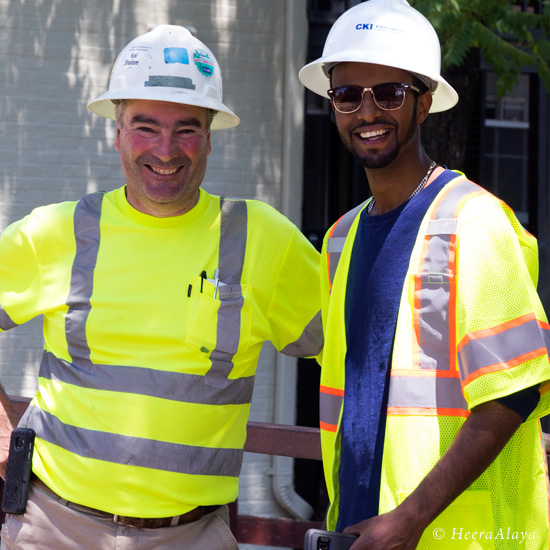
We are all construction workers. I serve as an inspector on this project [gesturing to his colleagues]. He is the foreman; those individuals are the flaggers; and the workers in the canal are the labourers.
What project are you currently working on?
We are addressing some structural issues with this old bridge, which was constructed over 150 years ago. The bridge has structural issues that render it unsafe. So we will close it, dismantle it and replace it with a new structure.
Can people cross over on foot?
Yes, but after we build a small pedestrian bridge. Then we will close the bridge and begin dismantling it.
Are you planning to remove the entire bridge?
Yes. But because this is a historic bridge, we will preserve the cast-iron pier—it won’t support any new structure—and return it when we are done rebuilding the new bridge. We will also do the same with the masonry—remove it and then reinstall it.
It sounds like an extensive project that requires significant planning.
It is [demanding and extensive]. The project is expected to last a year and a half.
What are the different phases of the project?
Do you see the large white bags [pointing to the bags placed in the canal]?
Yes.
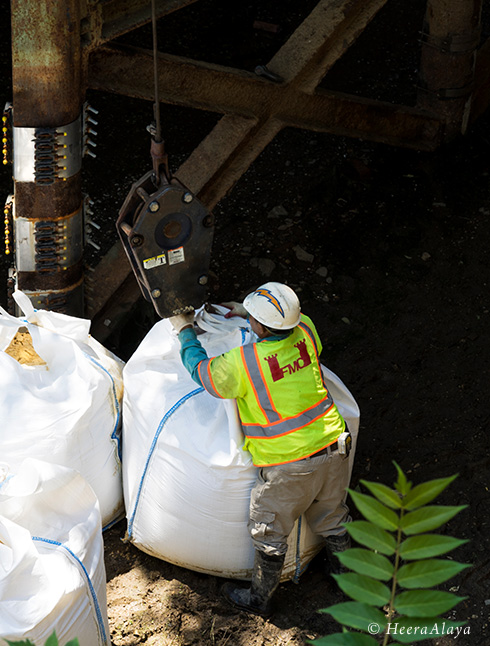
These white bags are full of sand. We shut down the water way back in the canal. Now we are going to let the water come through because there is life in the canal—fish and other ecosystem elements.
Ducks and ducklings inhabit this area, too.
Yes, ducks, too. And the longer we keep the canal dry, the more the grass will flourish, leading to higher mosquito populations that could impact residents. So we will allow water to flow through and construct a temporary dam to contain it, preventing any from entering the work zone during the bridge reconstruction.
These gnats and mosquitoes are shredding me; I can well imagine the crews’ plight.
It’s bad [the gnats and mosquitoes].
What measures are in place to prevent water from seeping into the crew’s work area?
The water can’t seep through—these watertight sandbags are heavy. And this is a cofferdam—
A cofferdam? What is that?
I appreciate your curiosity! A cofferdam is a temporary arrangement built to enclose an area where we can work. We pump out any water and dry the area.
What are the dimensions of this dam, and how long did its construction take?
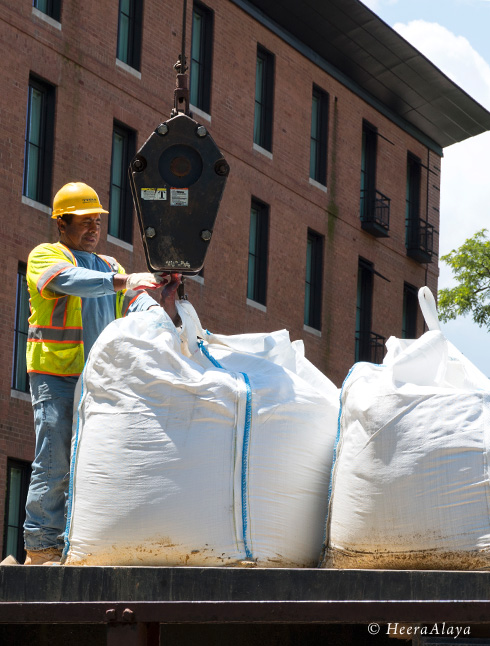
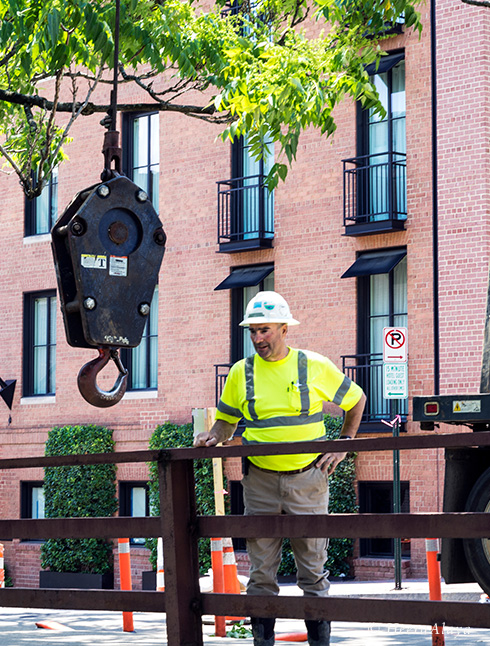
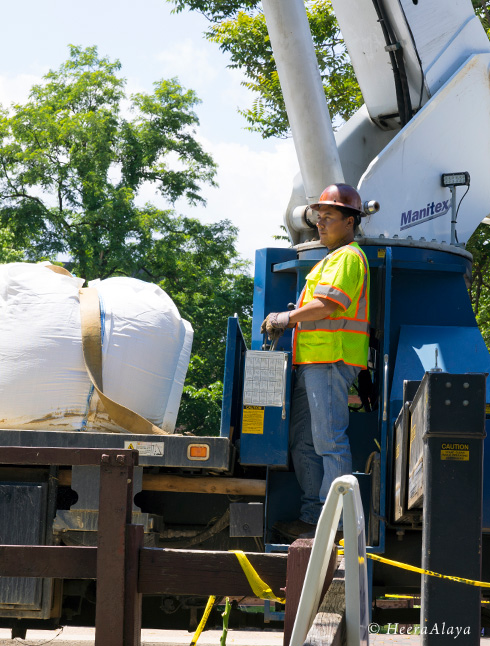
The dam is 54 feet wide and was completed in about three days. We utilise cranes—like the one you see—to lift and position these sandbags in the canal. The mini excavator, that yellow one down there, arranges the sandbags.
You mentioned allowing the water to flow downstream. Is the water regulated upstream?
Yes. If the water hadn’t been turned off upstream, the water level would have risen significantly—potentially reaching the sandbags.
The area needs to be reasonably dry before we can begin work. When was the water shut off?
The responsibility for shutting off the water in this area lies with the National Park Service.
Ah, so it’s a well-coordinated effort—the National Park Service ensures the water is turned off in time for you to commence your work.
That’s right.
How many crew members are currently involved in this phase?
We have eight workers on-site: two flaggers to manage traffic (since we have only one lane now), a crane operator, the foreman, three men who help the foreman with dam setup, and me. As the project advances, more personnel will join us.
What is the country of origin for the crew members? You are originally from Ethiopia, and another crew member mentioned he hails from Mexico—
There are many Portuguese and Spanish people, as well as people from El Salvador and Guatemala.
How challenging is the work your crew is undertaking?
Our job is difficult and carries significant risks. When construction crews work on bridges over water, their safety is jeopardised. The crew must descend the ladder and manage the crane to manoeuvre the sandbags as they go down.
My role, on the other hand, is more straightforward; I oversee operations, ensuring everything runs smoothly, that the appropriate materials are used, and that we take precautions to prevent accidents. When the crew arrive in the morning, they carry equipment and large signs on their shoulders and place them in the correct positions to inform the public that construction is ahead and to prepare them for only one lane.
The construction team also works through challenging weather conditions, rain or shine.
That’s right.
Earlier, I spoke with one of the crew members during his lunch break and asked if I could sit beside him on the pavement to chat. He invited me to join him, and it was a humbling experience to witness the hard work these men put in, taking breaks to eat lunch right on the pavement.
Thank you. Few people appreciate what we are doing now, but most do not. Everyone seems to be in a hurry, focused solely on themselves. However, if you take a moment to observe our efforts, you’ll realise we are not just working for a paycheck; we are also committed to safety. These guys [the crew] have lives, too—they have families and want to go home safely.
What is a typical workday for the construction crew?
A regular workday for the construction crew begins at 7:00 am and runs until 7:00 pm, Monday through Friday. Special permission is required to work on Saturdays. Most workers leave their homes around 5:00 am, as they first need to travel to the company location, load equipment onto the company vehicle for that day’s job, and then arrive at the construction site.
At the end of the workday, the crew return to the company to offload the equipment before heading home, usually arriving back around 9:00 pm. Commute times can vary depending on where the construction workers reside; some live very far away, so they face longer commutes. Personally, I wake up at 5:30 am every day. Since I don’t go through a company, I head directly here.
Construction work is incredibly demanding. The crew often has little time for their families, working Monday to Friday and sometimes even on Saturdays.
How do you handle rain, especially on projects with wet ground?
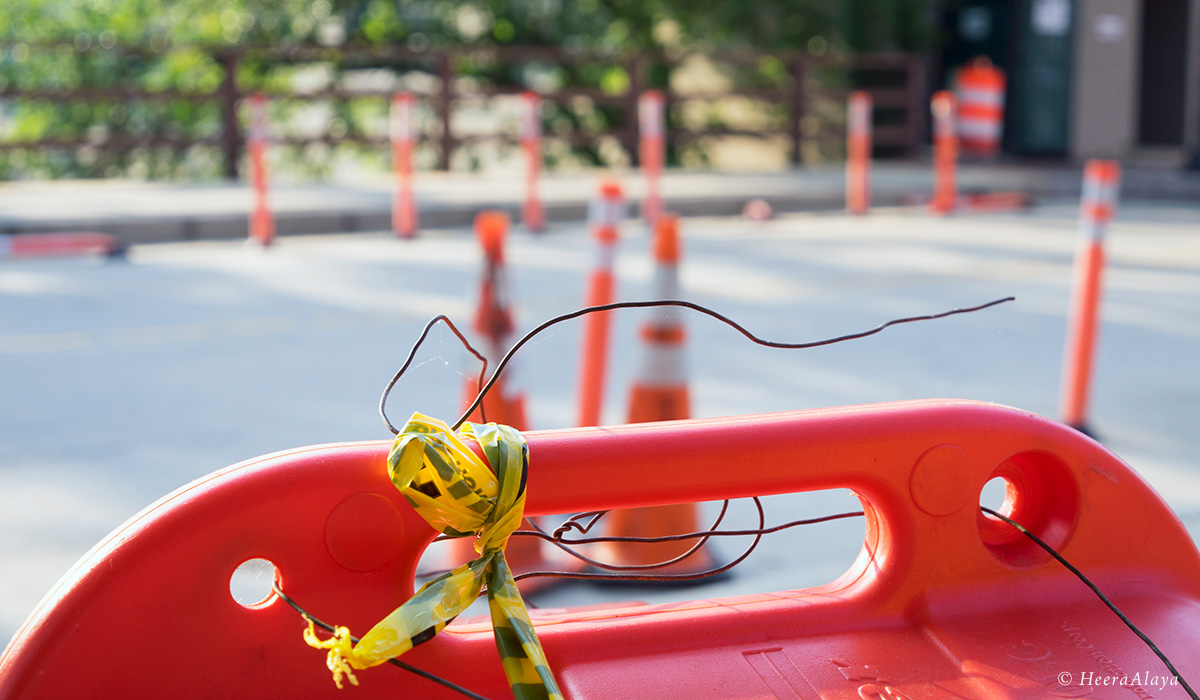
For rain and snow events, we must implement erosion and sediment control plans to effectively manage the site.
What exactly are erosion and sediment control plans?
These plans ensure that nothing from the construction site spills onto the road or affects nearby establishments. We take measures to prevent any leakage from the project site that could harm adjacent areas.
What challenges do you face as an inspector?
For me, the challenges extend beyond just the crew on-site; they also encompass the community—people who live and run establishments near the site areas and manage traffic flow. When people park haphazardly near the construction site, flaggers get tired, which can lead to tension between them and drivers. You see that guy–the flagger–he’s going to be there the whole day, and he’s going to be tired. A vehicle owner and the flagger will throw words at each other, and I have to tell the flagger to calm down and find the driver a nice space to park for a minute; this is part of my job, too.
Dealing with people can indeed be a challenge.
Yeah. So it’s not only about the project and the materials; the people come first. The crew can’t use anything that isn’t allowed. I won’t say anything, but since I am the one who approves everything, I will not pay for it. But if they do something that could affect the community, I have the authority to halt the project immediately.
That certainly highlights the authority you hold as an inspector.
Yeah. But we try to work together. For example, the foreman has been working for this company for 32 years, and we both worked together on a parkway project; I have known him for a long time. [Pointing to the foreman] That guy over there, can you see him?
Yes, I’ve met the foreman; he seems like a pleasant person.
It’s nice of you to say hello to the crew. The foreman [who is from Portugal] is a humble man; I have never seen him get angry. He [the foreman] is really nice, and the guys who work with him love him.
What are the responsibilities of a foreman?
The foreman serves as the primary leader on the project, essentially acting as the project manager.
So, the crew has to take orders from the foreman.
Yes, the crew must follow the foreman’s instructions. And if any issues arise, only I have the authority to communicate with the foreman, not the crew.
The foreman has been with the company for 32 years and is salaried.
Yes. Even though the foreman is salaried, he is expected to work 50 hours per week without receiving overtime pay; that’s the disadvantage.
Construction work is challenging. For example, I hold a degree in Civil Engineering, but am studying IT [Information technology] because construction does not pay well. Not only that, but your life is also always in danger. By the age of 60, due to the physical toll of the job, most crew members have had hip or spinal cord surgery.
Does the crew work during heavy snowfall?
The crew doesn’t work on heavy snow days. To get paid, the crew has to be on-site and working. In the construction industry, to receive pay, you must be physically present and working. When you work with the company for 30 or 40 years, they put you on a salary. However, on snow days, you’re expected to work inside to meet the company’s weekly hour requirement for salary, which can be quite challenging.
At what age do construction workers start their careers?
The foreman began his journey in construction 30 years ago, so he must be around 52 now. The foreman started as a construction worker and gradually worked his way up, which is commendable.
On my last project, a colleague told me he started working for a company (not this one, another one) when he was 16. He now earns only $22 an hour, which seems insufficient after 22 years in the field.
Will there be an inaugural ceremony for this bridge? And will the crew and you be invited?
I believe so, but I’m not certain if we will be invited.
I ask because it often seems that individuals in suits step forward to take credit and revel in the celebrations, which is rather unfortunate. Would you prefer a system that acknowledges the contributions of the right people?
Of course, it will mean a lot if they recognise the crew’s work, even if it’s a small gesture like a certificate. One of my mentors, Jerry, worked at my previous company for 40 years. Every time Jerry finished a job, he would take a penny and stick it to the ground. So if you see a penny around a bridge, you know Jerry built it.
Even during his time, the company owners didn’t truly value Jerry’s contributions. In the 40 years Jerry worked, the company changed hands three times, and although Jerry knows the company’s history, no one credits him for it. Jerry once said, “Some people think the world revolves around them; no, we are part of a team. The world is a circle, and we are part of the arc; we are not in the middle.” We have to be nice; it doesn’t cost a thing.
How would you like attitudes toward people in the construction industry to change?
When I was studying, I often heard medical students on campus asserting their importance because they save lives. The rest of us students would joke, “Okay, you can save one person at a time in an hour or two hours. But we can kill hundreds of people in a second just by building a bridge with a small mistake. And you can’t work unless we first build the hospital.” Everyone works together, which is beautiful; we must integrate.
People sometimes try to show you that they are superior. Life doesn’t work that way. Everybody has their responsibility; we live together. That’s how we grow together. If I am not here, you won’t be here. I have a small contribution to all the people here.
When I expressed my interest in speaking with you, you agreed. Why is that?
What do I have to lose by talking to you? Everything has a reason. You have a reason to come to me, and I will take it and explain our work. If you do something good for people, you will get it back. It makes you happy.
That’s a great attitude.
Sometimes, we hesitate to approach people.
That’s true. People pass by and ask me, “What’s going on?” And maybe, “Where are you from? You have a different accent.” When I share that I am from Ethiopia, they typically respond, “Okay,” and walk away. And I want to ask them if they know about Ethiopia.
Unfortunately, many may not be familiar with Ethiopia or be interested in learning about the world.
That’s true. I am not judging, but most Americans know only about America, unlike Europeans, who tend to be more knowledgeable about other parts of the world.
BEING A BEACON
emblematic of my essence
RECLAMATION
owning my narrative
CORONA DI ALLORO
wear your crown
KATE BLEWETT
Bulgaria’s Forgotten Children
THE MARIONETTISTS
The master manipulators
AJEET SINGH
we know of a baby who was raped
GAURI MAULEKHI
Animal rights campaigner, IN
“Artificial insemination [AI] is extremely traumatising for cows (she has to be restrained); it’s as traumatising as it would be for a woman if a hand were shoved up her vagina.”