
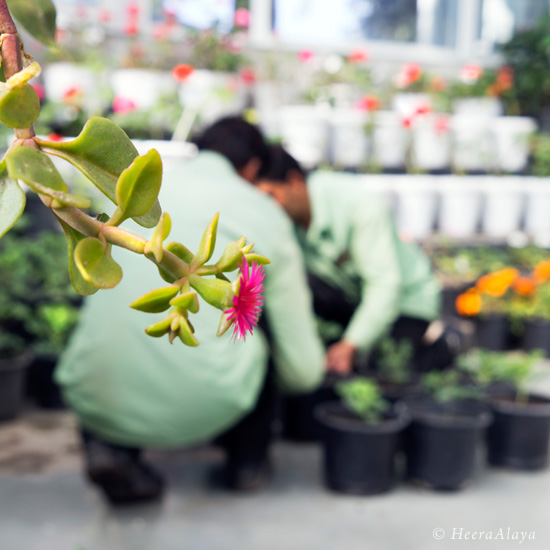
“When someone appreciates our work, we feel happy
to learn that we are doing a good job.”
ANIL SINGH and DIWAN SINGH
Gardeners, IN
October 1st, 2021
Heera Alaya: Namaste, my name is Heera. What are your names?
Anil and Diwan Singh: [The gardeners answer in succession] My name is Anil Singh. And my name is Diwan Singh.
Do you have a few minutes to spare?
Anil: Yes.
I am delighted to see how well you maintain the greenhouse, from its presentation to its cleanliness. I have had the privilege of experiencing stunning conservatories in other countries. Unfortunately, I don’t see orderliness and cleanliness anywhere in India, except on Indian Army campuses.
Diwan: Thank you, Ma’am. We have a supervisor who guides us on what to do. There is constant maintenance, and we feel pride in caring for plants and our surroundings.
What guides you in grouping and arranging pots to create a visually appealing display?
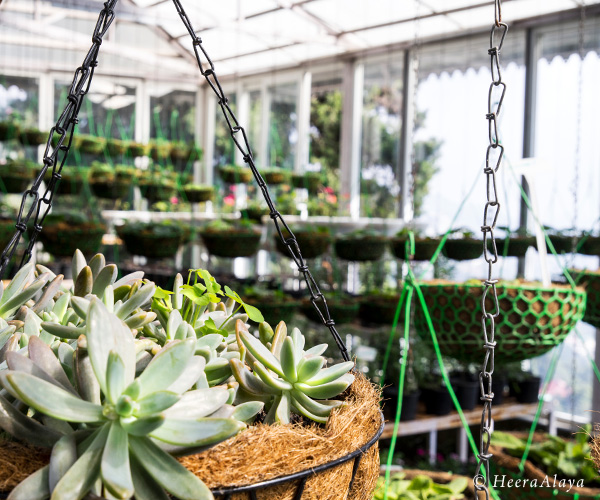
Diwan: We arrange and hang pots by estimating, looking and feeling; we have a sense of what looks good.
Following your eye suggests that you have been gardening for a while.
Diwan: You are correct; I have been a gardener at this property for six years.
Anil: I have been at this property for three years, and before that, I worked at Jim Corbett National Park.
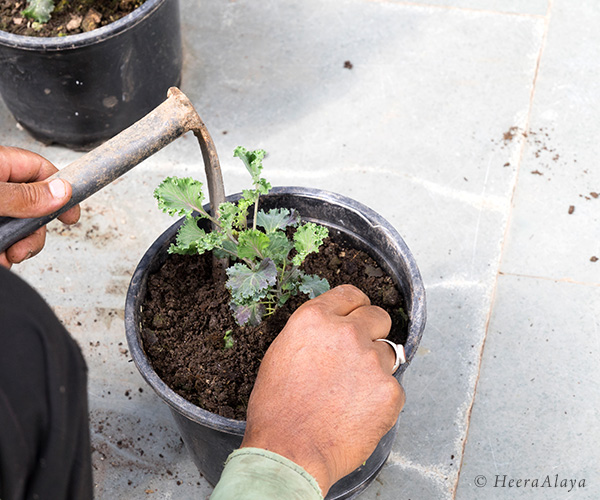
Who taught you how to garden?
Diwan: I learned through hands-on experience on the job.
Anil: Me too; I also learnt on my own.
What do you value about your work?
Diwan: I like caring for plants.
Anil: I like being amid plants and flowers.
Diwan: The blossoming flowers are beautiful. And when someone comes in and appreciates our work, we feel happy to learn that we are doing a good job.
I recognise the geraniums and chrysanthemums. What are those red flowers by the window?
Diwan: Those are red salvia.
[Pointing towards the fuchsias] And what about those pink and white flowers?
Diwan: Those are dianthus. We also have cineraria saplings.
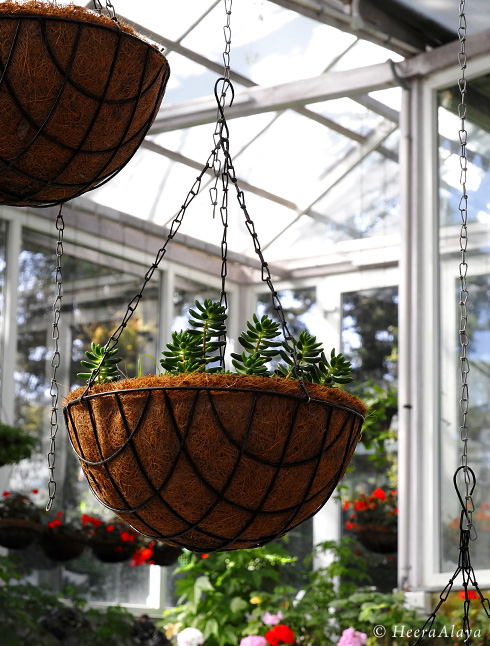
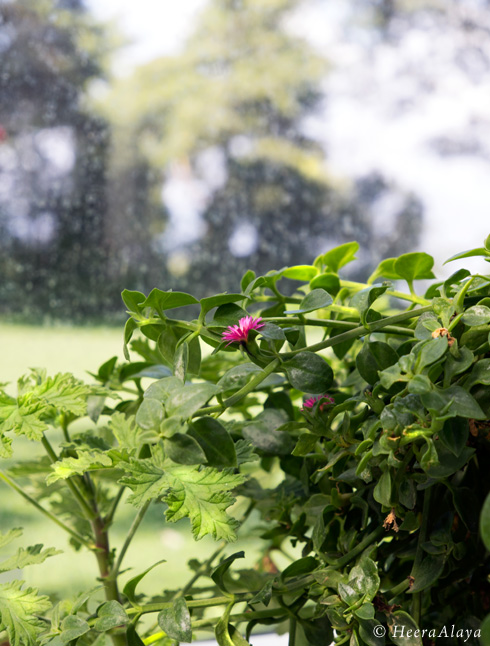
You prepare the seedlings in the greenhouse before transferring them to the outdoor garden.
Diwan: Yes.
How long do the seedlings need to stay in the greenhouse?
Anil: The duration varies—some seedlings stay [in the greenhouse] for two months, while others for four months.
What is your first task of the day?
Diwan: We start at 7:00 a.m. and continue until 4:00 p.m. The first thing we focus on is watering the plants. Then, we have to give specific plants medicines, after which we move on to other tasks.
Do you both work as a team all the time?
Diwan: No, there are times we work separately. The property also employs around five female gardeners to care for the sprawling gardens.
How time-and effort-consuming is gardening?
Anil: Maintaining the greenhouse and gardens takes a lot of time. Apart from tending to plants, we have to remove weeds, which could take a couple of hours to four hours a day. And there are days when it takes up an entire day. Plus, we attend to repairs and keep the areas tidy.
Gardens are easy to admire, but the work behind them is challenging for gardeners.
Diwan: What you say is true. [Pointing to a plant] Take this plant; it’s three months old; it will start flowering when it’s five months old. We have to take care of plants, just as we would a child.
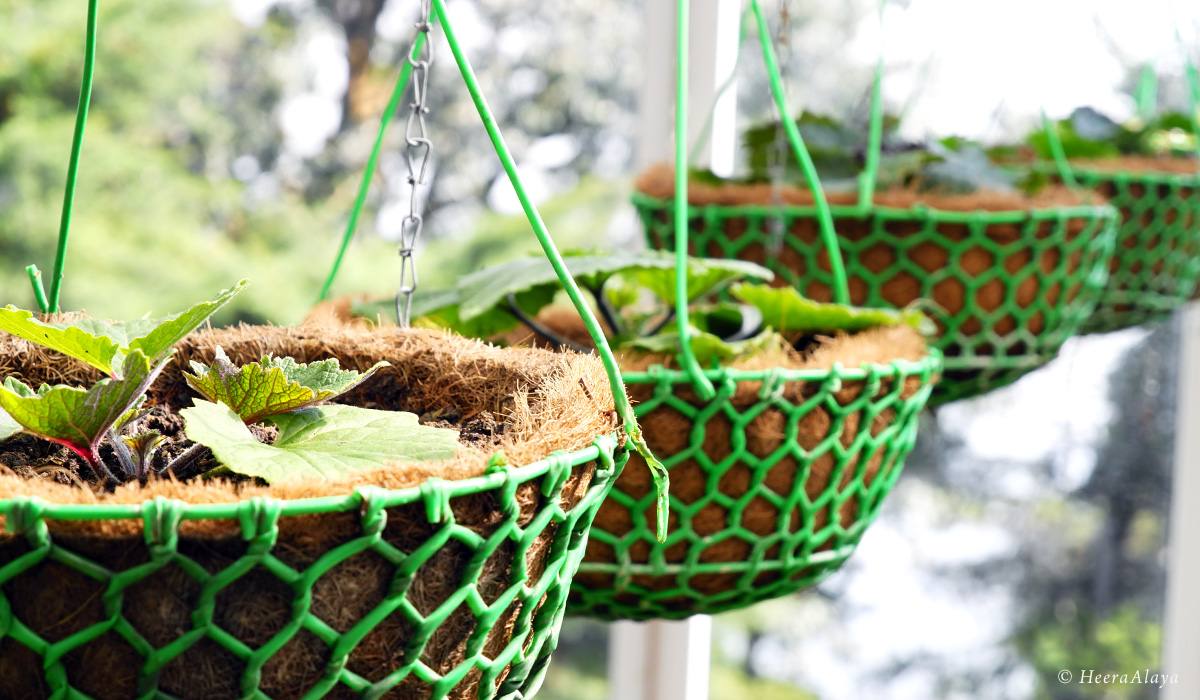
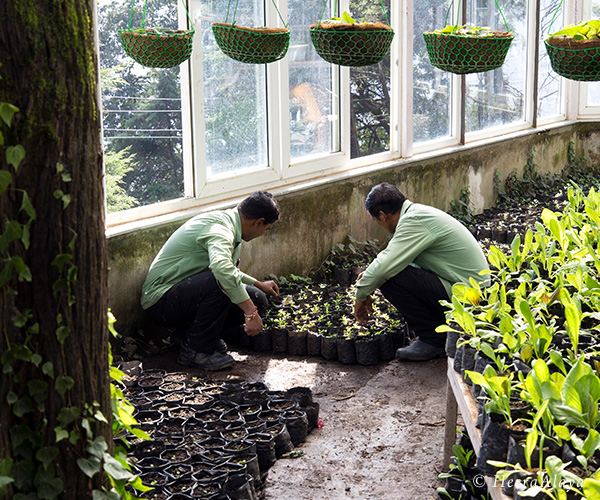
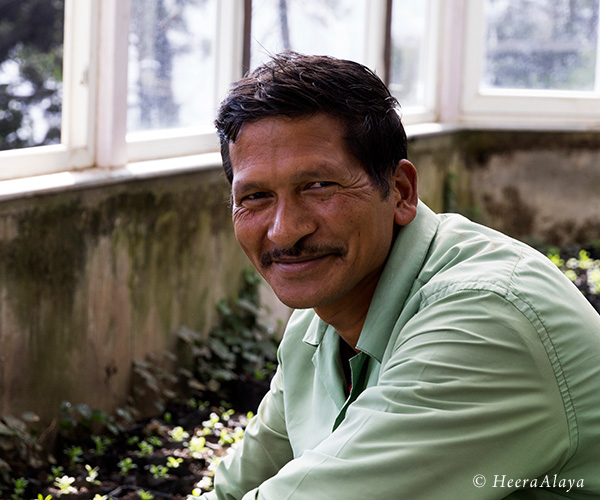
There are a lot of monkeys in this area; how do you protect your plant-children from them?
Anil: They [the monkeys] break plants and pull out saplings. If the monkeys like it, they eat it; if not, they throw it. We always chase them, but they [the monkeys] return.
Monkeys can be destructive, but humans can be, too. How do you feel when people disregard the plants you nurture day in and day out?
Diwan: Many people engage in this kind of disrespect towards nature. It takes five to six months to tend a seed into a sapling, so it hurts when someone destroys the plant. When we maintain our environment, the plants will look good, blossom and add to the beauty of the surroundings.
Anil: I want to add that children and adults often consume food and then carelessly discard the packaging into flowering plants and bushes; they must refrain from such behaviour. No matter where you go, maintain a clean, clutter-free environment. Filth and pollution cause many diseases, like dengue. So cleanliness is essential.
Do you feel proud of your clean surroundings?
Anil: Oh, absolutely, Ma’am. If we find our surroundings beautiful, others who visit will too.
What practice helps in keeping this space clean and organised?
Diwan: The best approach is to clean as you go. Unfortunately, many people are careless and wait for someone else to clean up after them.
True.
What makes you feel connected to your work?
Anil: I am attached to my work because I enjoy seeing greenery. Ma’am, beauty and greenery are essential. I will tell the younger generation to maintain beauty and keep plants in their homes and balconies.
You mentioned earlier that you have a supervisor. Is it favourable to have someone to give you direction and guide you with your work?
Diwan: Oh yes. There is a guru and then the chela—the leader and the follower. When the guru imparts knowledge, it’s a plus for us because he teaches us. If we fall short, the guru will point it out, and when we correct our mistake or oversight, we will take care of it better, which the guru will appreciate.
It’s rare to hear these sentiments. I greatly appreciate you both.
[In unison] Thank you, Ma’am.
How do you refer to this greenhouse?
Diwan: Nursery.
Anil: A home for plants.
What an apt description—a home for plants!
It was lovely talking with you. Thank you. Namaste.
Diwan: Even we feel good. Do come again.
Anil: Thank you. Namaste.
JARDIN DANS UN JARDIN
amalgamation of art, science and patience
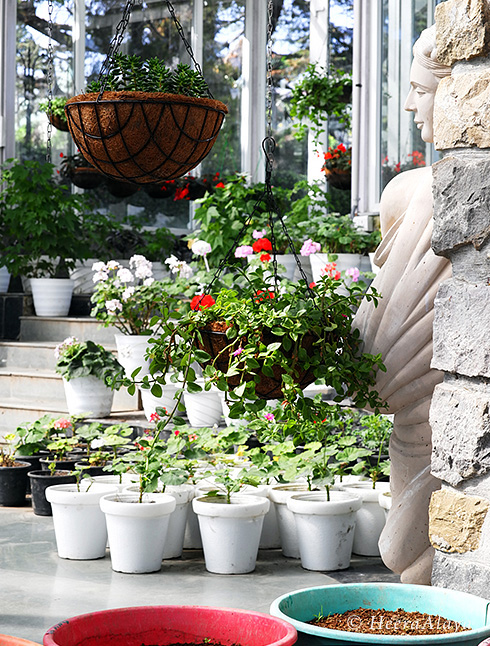
By sheer chance, the garden supervisor—who has dedicated nearly 27 years to this profession—entered just as I was concluding my conversation with the gardeners. I was struck by the mutual complementarity between the supervisor and the gardeners. When I brought up the greenhouse aesthetics and inquired about the high standards, the supervisor praised, “The gardeners do an excellent job of housekeeping,” and elaborated, “Aesthetics plays a crucial role in both the greenhouse and gardening. [Pointing to the hanging pots] “You see, we have used iron chains to hang plants at the same level. The height of the baskets can vary, but when we hang them with the iron chains, they look more or less symmetrical.”
Driven by his passion for gardening, the supervisor enthusiastically shared his expertise: “Given the hill station’s climate (with its snow and frost), we cultivate seasonal flowers, ensuring blooms throughout the year. Like the winters, the monsoons are severe and challenging, so we grow only those species of plants that can handle a lot of rain.”
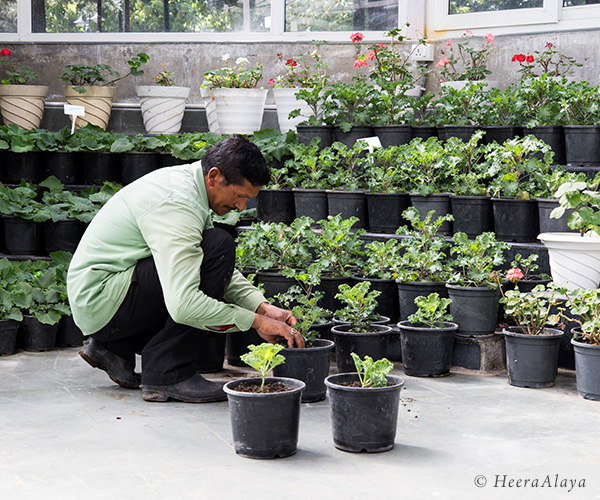
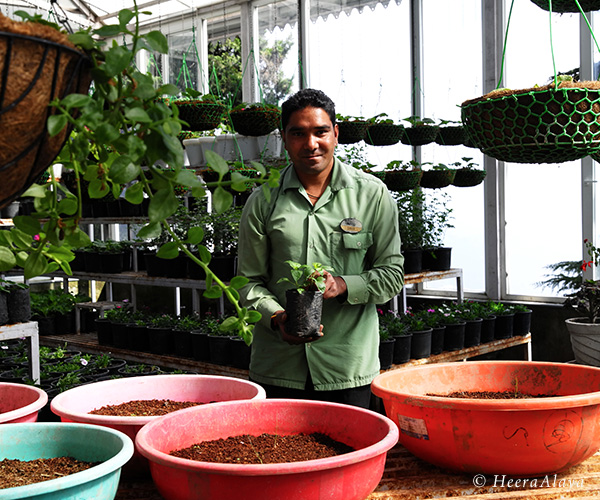
Taking a cue from the barely-there, shy saplings, I enquired after them. “We don’t buy seedlings; we purchase seeds from our suppliers based in Calcutta [now known as Kolkata, capital of West Bengal, India]—and then we initiate a germination phase according to the season. Once the seedlings begin to take form, we place them in seed trays from where we transfer seedlings to nursery bags or small pots, depending on their strength, the appearance and timing for when they can be moved outside,” the supervisor explained.
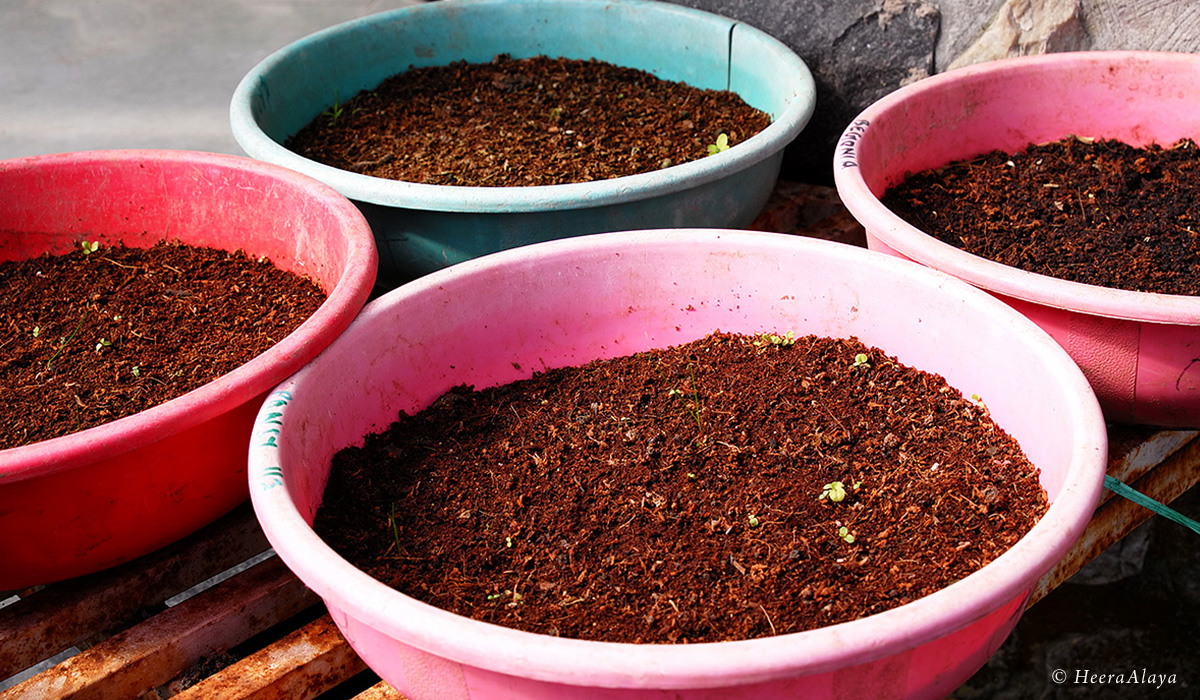
Given the significant effort dedicated to nurturing delicate plants, I found myself questioning the supervisor’s thoughts towards individuals who pluck, trample, spit on, and extinguish cigarettes on the flora and lawns they have painstakingly tended, rather than being inspired by the beauty of their surroundings. The supervisor reflected the sentiments of the gardeners, stating, “Well, I feel pity for their attitude, not people. It [destruction of nature] is not appreciated. So I appeal to people that if they don’t love nature, at least don’t hate it. Sometimes, people think gardening is a walk in the park—you pluck a tree branch, put it in the ground, and it grows automatically. It is not the case—gardening is time-consuming. Gardening also requires money and lots of gratitude.”
Over the years, I have frequently encountered garden designers, gardeners, and landscapers asserting that gardening is not as physically demanding as other professions. The supervisor even quipped, “Plants won’t ditch me, and neither will they misbehave with me,” eliciting a chuckle from me, as his words ring true. However, I believe gardeners and landscapers are modest. Observing Anil and Diwan—two dedicated gardeners whose shared philosophy of care brings to life an exquisite garden in the foothills of the Himalayas—has made it clear that behind the surface of beauty and calm lies immense responsibility, effort and stress.
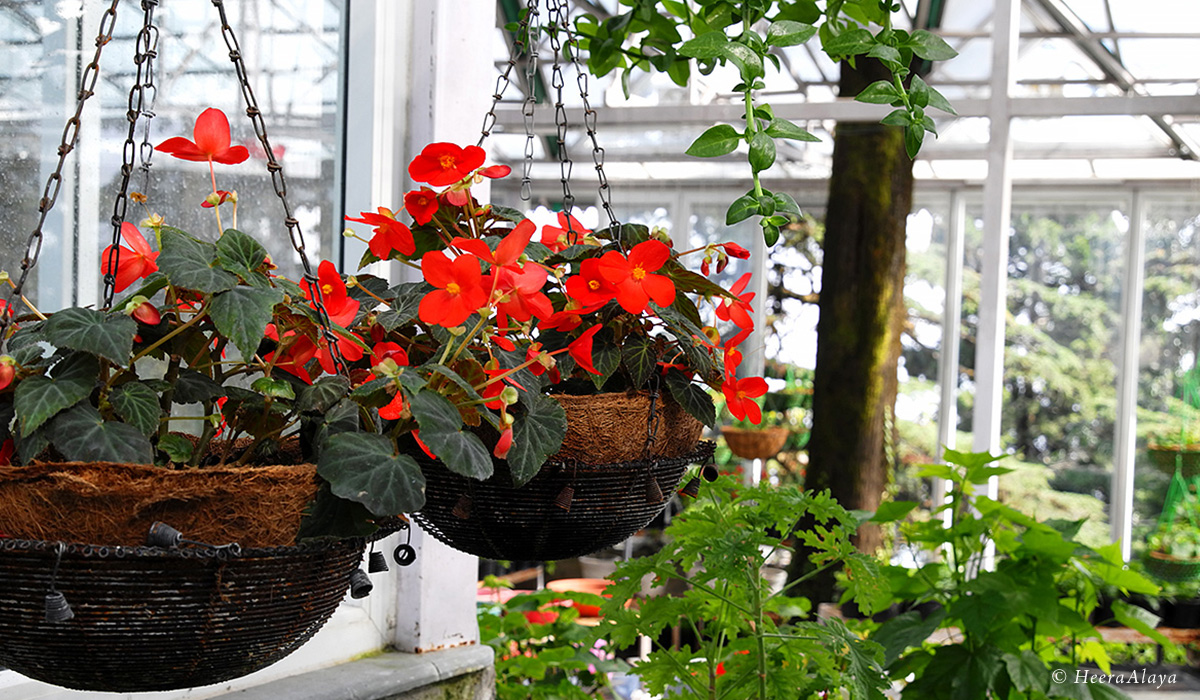
On the one hand, it’s a blessing to have an innate understanding of soil and wind; on the other hand, it’s a present challenge to wrestle with weather elements—humidity to hail and hurricanes! Let’s not forget the annoyance of dealing with gnats, mosquitoes, creepy crawlies and stinging zoomies. A special mention goes to the self-invited adorable chomping brigade—ranging from rabbits to monkeys! My takeaway from gardening has always been that it is as much a science as an art, requiring incredible skill and enormous patience, for which we must be grateful.
BEING A BEACON
emblematic of my essence
THE MARIONETTISTS
The master manipulators
FRENCH LAUNDRY
restoring your soul’s hygiene
EUDAIMONIA
amalgamations and elucidations
ABSTRUSE IDYLLIC OASIS
comprehending complex tapestries
RESURRECTION
systematically isolated to perish
JO-ANNE MCARTHUR
Photographer for Animals, CA
“Cows are constantly re-impregnated, and their babies are taken away for slaughter so we can drink the milk.”